
How long do solar panels last? Longer than most people expect, and longer than the parts around them. That gap is the useful answer, because panels are rarely what gives out first.
If you are judging whether a rooftop solar system is a sound long-term investment, lifespan matters more than almost any other specification. A system that pays back and then keeps producing for years afterwards is a very different proposition from one that needs major work soon after it breaks even.
How long do solar panels last: the short answer
Solar panels do not usually fail. They degrade, meaning output declines slowly and predictably year after year while the panel keeps working.
Manufacturers back this with two separate warranties:
- A product warranty, covering manufacturing defects and physical failure.
- A performance warranty, guaranteeing the panel will still produce at least a stated percentage of its original output after a given number of years.
Those terms vary by manufacturer and have generally lengthened as the technology has matured. Read the actual warranty document for the panel you are being quoted, because the brochure claim and the legal document are not always the same thing.
What this means practically: panels are the longest-lived component of your system, and the realistic expectation is that they will still be generating usefully long after the inverter has been replaced.
What actually fails first
In order of how often it comes up:
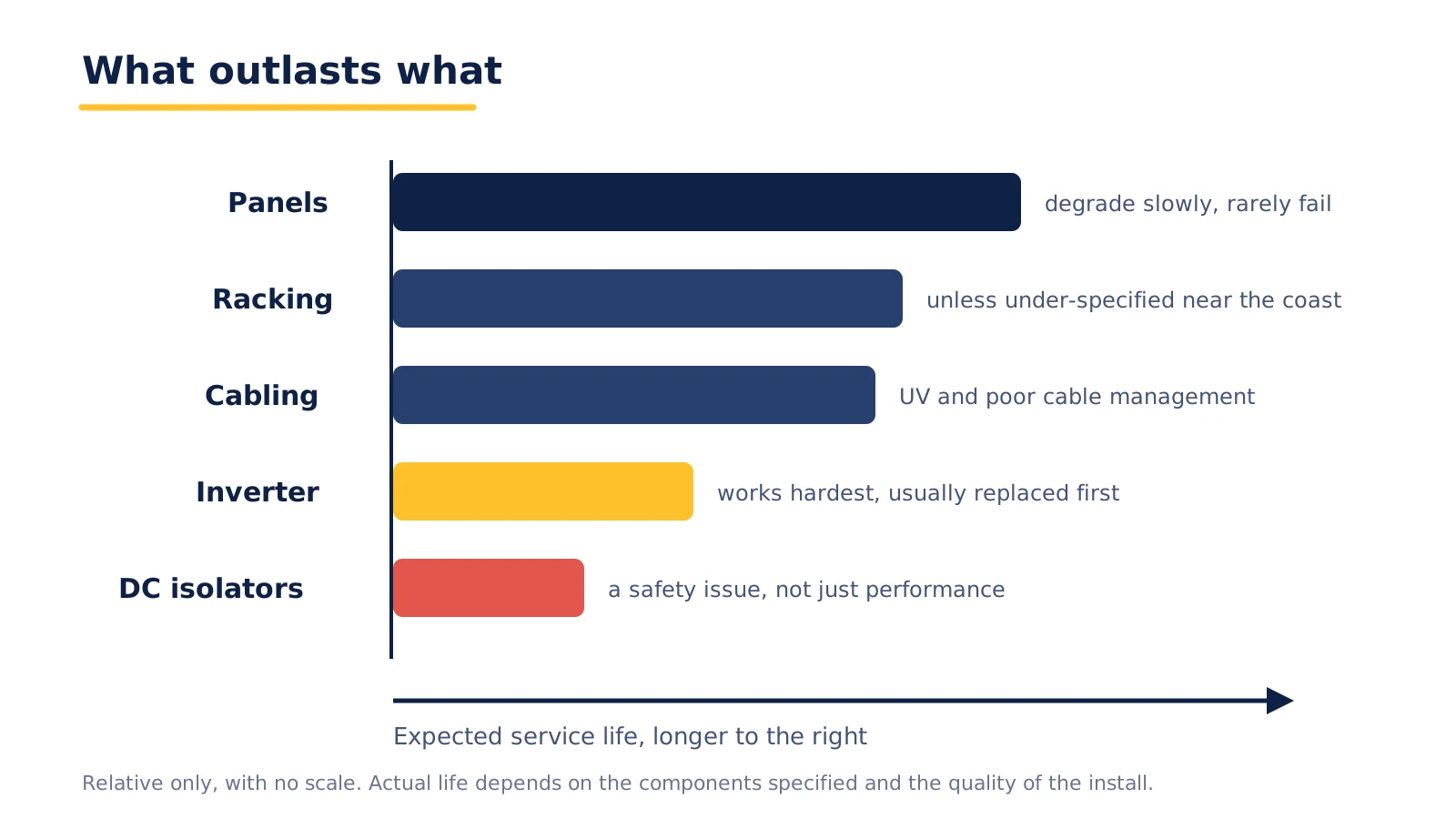
1. The inverter. It is the most electronically complex part, it works hardest, and it carries a shorter warranty than the panels. Budgeting for a replacement is sensible planning rather than pessimism.
2. DC isolators. These have a poor reliability record in Australia, driven by water ingress and UV degradation. Because a DC arc does not self-extinguish the way an AC one does, a failed isolator is a safety issue rather than a performance one. On any system more than a few years old, this is the component most worth having inspected.
3. Mounting and racking. Should outlast the panels if specified correctly, but under-specified racking near the coast corrodes, and poorly flashed roof penetrations leak. Both are workmanship problems rather than wear.
4. Cabling and connectors. UV exposure and poor cable management cause failures that look like panel faults and are not.
5. The panels themselves. Microcracks, delamination, hot spots and failed bypass diodes do happen, but they are the least common of the five.
The pattern is worth internalising: the things that end a solar system early are almost always installation quality and balance-of-system components, not the panels. That is the strongest argument against buying on price alone.
What shortens panel life in Australian conditions
Heat. Panels lose efficiency as they get hot, and sustained high temperatures accelerate ageing. Adelaide summers are genuinely harder on equipment than milder climates, which makes proper roof ventilation clearance and sensible component selection worth more here.
Salt. Coastal sites need corrosion-appropriate mounting and panel frames. This is a specification question and cheap quotes skip it.
Hail and storm. Panels are tested to withstand hail, but severe events cause real damage, sometimes invisible from the ground. We have set out what to check in what to do after a hailstorm hits your solar panels.
Soiling. Dust, pollen, salt and bird droppings reduce output. Mostly reversible with cleaning, though long-term bird nesting under an array causes lasting damage.
Shading. Partial shading does not shorten physical life but it does create hot spots that stress cells over time.
Does output drop steadily or suddenly?
Steadily, and that is how you tell ageing from a fault.
A gradual year-on-year decline of a small percentage is normal degradation. A sudden drop is a fault: an inverter error, a failed isolator, a string offline, new shading or heavy soiling. Seasonal variation is also normal and should not be mistaken for either, which is why comparing like month against like month matters.
If your output has fallen and you are not sure which you are looking at, the diagnosis is usually straightforward. The usual causes are in five reasons your solar panels are not saving you as much as expected, and the seasonal question is covered in do solar panels work on cloudy days and in winter.
How to make a system last
Five things, in order of impact:
- Buy on installation quality, not panel brand. Cable sizing, isolator placement, roof flashing and racking specification determine lifespan more than the glass does.
- Specify for your location. Coastal corrosion, extreme heat, high UV. These are design inputs, not afterthoughts.
- Have it inspected. An annual or biennial check of inverter error history, isolator condition, mounting integrity and actual output against expected output catches problems while they are cheap.
- Clean it when it needs it, not on a schedule. Rain handles light dust. Bird mess and build-up under trees do not clear themselves.
- Keep your documentation. Compliance certificate, warranty documents and commissioning data. Warranty claims fail on missing paperwork more often than on disputed facts.
What happens when the warranty ends
A performance warranty expiring does not mean the panels stop. It means you no longer have a guaranteed output floor, and the system continues producing at whatever its actual output has declined to.
At that point the economics are usually excellent, because the system is long since paid for and every kilowatt-hour is free. The practical decision is usually whether to add storage, replace an ageing inverter, or add panels, rather than whether to remove the system.
For the detail on warranty terms and how a claim works, see our article on understanding solar panel warranties.
Frequently asked questions
How long do solar panels last in Australia?
Panels are the longest-lived part of a solar system and typically keep producing usefully for decades, declining slowly rather than failing. The manufacturer’s performance warranty states the minimum output guaranteed after a given number of years, and that term varies by brand, so check the specific warranty document.
Do solar panels stop working after their warranty expires?
No. The warranty is a guarantee of minimum output, not a service life. When it expires the panels continue generating at whatever output they have declined to, and by then the system is usually long since paid for.
What part of a solar system fails first?
Almost always the inverter, because it is the most complex component and works hardest. DC isolators are the next most common failure point in Australian systems, and that one matters for safety as well as performance.
Does hot weather shorten panel life?
Sustained high temperatures do accelerate ageing and also reduce efficiency while panels are hot. It is one reason proper mounting clearance and sensible component selection matter more in hotter parts of Australia.
Is a sudden drop in output normal ageing?
No. Degradation is gradual. A sudden drop points to a fault such as an inverter error, a failed isolator, a string offline, new shading or heavy soiling. Have it checked rather than assuming the panels are simply old.
Can I replace individual panels later?
Sometimes, though matching an older panel’s electrical characteristics can be difficult and a mismatched panel can drag down its string. It is a question for your installer rather than a straightforward swap.
Do panels need replacing before I add a battery?
Not usually. What matters more is inverter compatibility and whether the existing system can support storage. We cover that in our article on adding a battery to an existing solar system.
More on that last point in can you add a battery to an existing solar system.
Where to go next
The practical conclusion is that longevity is bought at installation, not chosen from a brochure. How long do solar panels last on your roof depends far more on who installs them than on whose name is on the glass, and the components that end systems early are the ones nobody advertises.
If you are specifying a new system, work out the right size first with our solar and battery savings calculator, then look at the options on residential solar. For the complete picture on sizing, costs and components, see our guide to solar power in Australia.
Sources
- Australian Government Solar Consumer Guide: solar
- Australian Government: Solar PV and batteries
- Australian Competition and Consumer Commission: consumer guarantees