
Do solar panels work on cloudy days? Yes. They produce less, not nothing, and the difference between those two things is where most of the confusion sits.
It is one of the most common questions people ask before committing to a system, and it deserves a straight answer rather than reassurance. If you are weighing up rooftop solar for an Australian home, what matters is not whether cloud reduces output, because it does, but by how much and whether that changes the decision.
Do solar panels work on cloudy days? The short answer
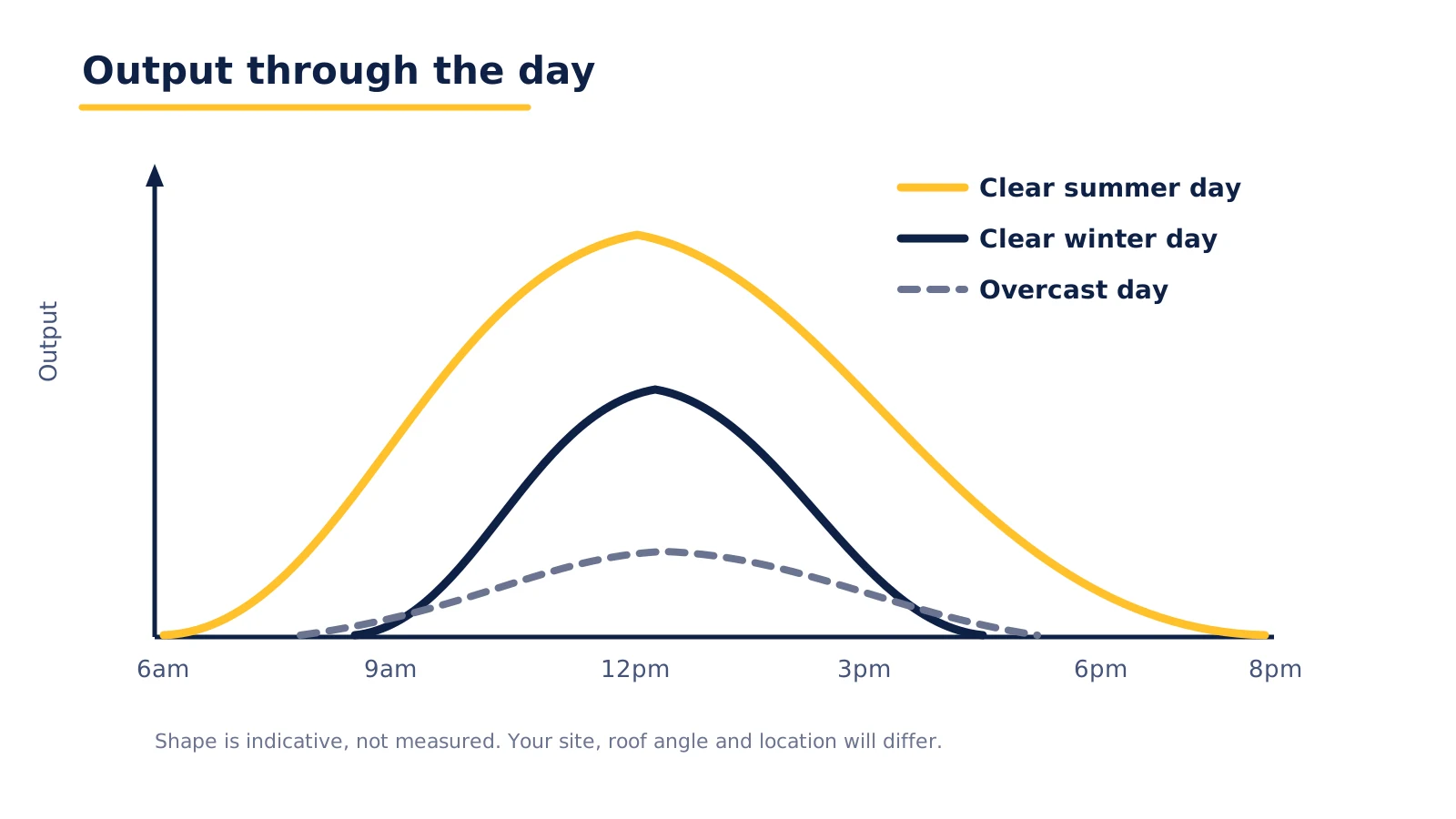
Solar panels respond to light, not heat. Cloud reduces the amount of light reaching the panel, so output falls. How far it falls depends on the cloud.
- Light high cloud or haze: a modest reduction. Many people do not notice it on their monitoring.
- Heavy overcast: a substantial reduction, often to a small fraction of a clear-sky day.
- Heavy rain and storm cloud: the lowest output you will see, though still rarely zero in daylight.
Winter is a separate issue from cloud and the two get muddled. In winter the days are shorter and the sun sits lower, so there are fewer hours of generation and the light strikes the panel at a less favourable angle. That reduces output even on a perfectly clear winter day.
Why panels sometimes perform better in cool weather
This surprises people. Solar panels lose efficiency as they get hot.
Every panel has a temperature coefficient, which describes how much output it loses per degree above its rated test temperature. On a 42 degree Adelaide afternoon, a panel can be considerably hotter than the air around it and is producing less per unit of light than it would on a mild day.
The practical result is that a cool, clear, bright day in spring or autumn can be one of the best generating days of the year, better than a scorching midsummer afternoon. If your monitoring shows a dip during a heatwave, that is normal physics, not a fault.
What winter actually costs you
Three things change between summer and winter, and only one of them is about weather.
Day length. Fewer daylight hours means fewer generating hours. This is the largest single factor.
Sun angle. A lower sun means light hits a fixed roof-mounted panel more obliquely, and passes through more atmosphere. Both reduce the energy arriving at the panel.
Cloud frequency. Depends entirely on where you are. Adelaide and Sydney have very different winter cloud patterns, and both differ from the regional areas around them.
What this means in practice is that a system sized only against your summer consumption will underperform your expectations in June and July. A properly sized system accounts for the seasonal swing rather than the annual average, and that is one reason a slightly larger array is often the better decision: it generates usefully earlier in the morning, later in the afternoon and through the weaker months.
What does not help
A few persistent myths worth clearing up.
Snow and frost. Largely irrelevant across most of Australia, and where frost does occur it clears quickly.
Tilting panels seasonally. Technically it would help. In practice, adjustable residential mounting is rarely worth the cost and complexity in Australia.
Buying “low light” panels. All modern panels generate in diffuse light. Marketing claims about exceptional low-light performance are rarely backed by a meaningful difference in annual yield.
Cleaning to fix winter output. Worth doing if the panels are genuinely dirty, but it will not recover the losses caused by short days and a low sun. If output has dropped more than the season explains, something else is going on, and we have worked through the likely causes in five reasons your solar panels are not saving you as much as expected.
What this means for batteries
Winter is when a battery is least able to help, which is the opposite of what people assume.
A battery can only store surplus you actually generated. On a short, overcast winter day there may be little or no surplus to store, because your household is consuming most of what the panels produce as they produce it. Batteries deliver most of their value in the warmer two thirds of the year.
That does not make a battery a bad decision. It does mean a battery should be sized against your typical generation surplus rather than your best summer day. If you are considering one, solar battery or feed-in tariff, which is better sets out the comparison, and what happens to your solar power after the sun goes down explains the overnight picture.
Frequently asked questions
Do solar panels work on cloudy days?
Yes, at reduced output. Panels respond to light rather than direct sunshine, so they continue generating in diffuse light. Light cloud causes a modest drop, heavy overcast a large one. Output in daylight is rarely zero.
Do solar panels work in the rain?
Yes, though output is low because storm cloud blocks most of the light. Rain has one upside: it rinses light dust off the panels, which slightly improves performance afterwards.
How much output do I lose in winter?
Enough to notice, driven mainly by shorter days and a lower sun angle rather than by cloud. The size of the drop depends on your location, roof orientation and tilt. Your own monitoring data from a previous winter is the only accurate guide for your site.
Do solar panels work better in summer?
Usually yes overall, because the days are long. But peak efficiency is not reached on the hottest days, since panels lose output as they heat up. Mild, clear days can outperform very hot ones.
Should I install a bigger system because of winter?
Often, yes. A larger array generates more during the weaker months and across the shoulders of each day, which is when households tend to be using the power rather than exporting it. Size it against your consumption pattern, not against your best summer day.
My output dropped suddenly. Is it just the weather?
Seasonal decline is gradual. A sudden drop is more likely a fault: an inverter error, a failed isolator, shading from new growth, or a string that has gone offline. If the fall does not match the season, have it checked.
Where to go next
If you came here asking do solar panels work on cloudy days, the honest answer is yes, at lower output, and the size of that drop is specific to your roof, your orientation and your location.
If you already have solar and your output through this winter has not matched what you expected, the cause is worth identifying rather than assuming. Book a free system health check and we will compare your actual generation against what your system should be producing for your location and orientation.
If you are still planning a system, size it against your full-year consumption rather than a summer estimate. Our solar and battery savings calculator is a starting point, and residential solar covers the system options.
Background on how generation works across the day and the seasons is in our guide to solar power in Australia.
Sources
- Australian Government Solar Consumer Guide: solar
- Australian Government: Solar PV and batteries