
Australia has more rooftop solar power per person than any country on earth, and yet most people shopping for it are working from a quote, a sales pitch and a vague sense that it pays for itself. That is not enough to make a good decision on a purchase this size.
This guide covers what solar power actually is, how a system works, what it costs, what size you need, where batteries fit, and how to tell a good installer from a bad one. It is written for Australian conditions, Australian tariffs and Australian rules. If you are considering solar power systems for homes and businesses in South Australia and New South Wales, start here and work down.
No prices are invented anywhere in this guide. Where a number moves, we say so and point you at the source.
What this guide covers
- What solar power is
- How a home solar power system works
- What a home solar power system includes
- What size system you need
- What solar power installation costs
- Where batteries fit
- Solar power for a house, shed or outbuilding
- Solar power in New South Wales and South Australia
- Finding solar power installers near you
- Looking after the system
- Solar power for business
- Frequently asked questions
What solar power is, in one paragraph
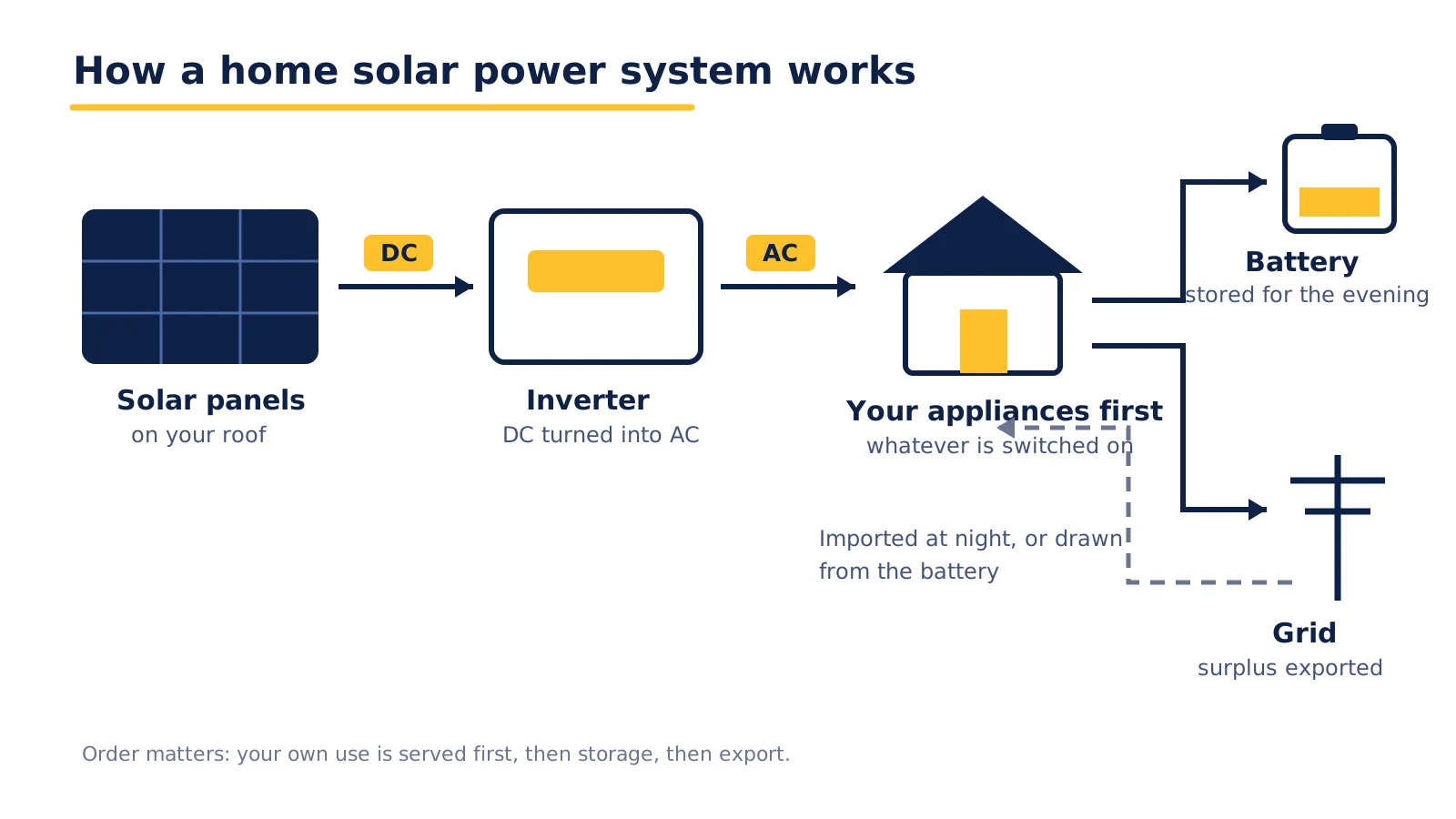
Solar power is electricity generated when sunlight hits a photovoltaic cell. Panels on your roof produce direct current, an inverter converts it to the alternating current your house uses, and the electricity flows to whatever is switched on at that moment. Anything you do not use is either stored in a battery or exported to the grid. Nothing burns, nothing moves, and there is no fuel to buy.
Solar power generation at household scale is the same physics as utility-scale power generation from solar farms. The difference is entirely one of size, mounting and grid connection.
How a home solar power system works, step by step
- Panels generate DC electricity whenever light hits them. Output rises and falls with light intensity across the day.
- The inverter converts DC to 230V AC and synchronises it with the grid. This is the brain of the system and the component most likely to need replacing first.
- Electricity flows to your loads first. Your fridge, air conditioner and hot water take what they need before anything leaves the property.
- Surplus goes to a battery, if you have one, charging it for later use.
- Any remaining surplus is exported to the grid, and your meter records it so your retailer can credit you.
- At night, or when generation is low, you import from the grid or discharge the battery.
The single most important consequence of that sequence: electricity you use at the moment it is generated is worth far more to you than electricity you export. We go into why below, and it is the thing most quotes gloss over.
What a home solar power system actually includes
People often think they are buying panels. You are buying a system, and the parts you cannot see matter as much as the ones on the roof.
A standard home solar power system comprises:
- Panels, mounted in an array sized to your roof and consumption.
- Racking and mounting hardware, specific to your roof type. Tile, tin and Colorbond all need different approaches.
- An inverter, either a single string inverter, multiple microinverters, or a hybrid inverter if you are planning a battery.
- DC and AC isolators, which are safety switches and a common failure point in older Australian installs.
- Cabling and conduit, run to standard.
- A compliant meter, which often means replacing or reconfiguring what you have.
- Monitoring, usually an app that shows generation and consumption.
- Documentation: your compliance certificate, warranties and network approval.
If a quote lists only panels, inverter and a price, ask what else is included. Switchboard upgrades and meter work are frequently needed and frequently left out of the headline figure.
What size solar power system do you need?
This is the question people ask second and should ask first, because solar power system size drives cost, savings and whether the system suits you at all.
Three inputs decide it:
- How much electricity you use, in kilowatt-hours per day, taken from twelve months of bills rather than a guess.
- When you use it. A household home during the day can consume most of what it generates. A household empty from 8am to 6pm exports most of it at a much lower value.
- What your roof allows, in usable area, orientation, tilt and shading.
Common Australian residential sizes run from around 6.6 kW through 10 kW to 13.2 kW and above. Larger arrays generate more in winter, earlier in the morning and later in the afternoon, which is precisely when a household is more likely to be using the power rather than exporting it. That is why sizing down to match a low export limit usually costs you more than the limit does.
Rather than guessing, put your bill into our solar and battery savings calculator, which works from your state and your actual bill amount and returns indicative system options.
What solar power installation costs
Nobody can give you an accurate solar power installation price without seeing your consumption, your roof and your switchboard. What we can do is explain what you are paying for, so you can read a quote properly.
Your installed solar power cost is made up of:
- Panels, which are now a relatively small share of the total.
- Inverter, where quality differences are large and matter.
- Racking, varying by roof type and pitch.
- Labour and compliance, including the electrical work and certification.
- Site extras, such as a switchboard upgrade, meter work, tile repairs or difficult access.
- Less the federal certificate discount, which is applied upfront and declines over time.
Two warnings worth more than any price list. First, the certificate discount is set by your installation date, not your quote date, so a delayed install can quietly reduce it. Second, a very cheap system is usually cheap because of the inverter, the racking or the labour, and those are the three things that determine whether the system still works in year eight.
If you need to spread the cost, solar power loans and finance arrangements exist and are offered by most retailers. Compare them on total cost over the term, not on the monthly figure, and be aware that finance content is regulated, so get the terms in writing.
Where batteries fit
Interest in solar power batteries for home use has grown sharply, and the federal discount on batteries has made the maths considerably better than it was.
What a battery does: it stores your midday surplus so you can use it in the evening, when you would otherwise be buying from the grid at the full retail rate. That is the entire financial case, and it gets stronger as feed-in tariffs fall.
What a battery does not do automatically: keep your house running in a blackout. Backup during an outage depends on how the system is configured and whether a backup circuit and the right equipment are included. If that matters to you, say so before the design is finalised, because adding it later costs more.
If you already have panels, you do not need to start again. We have covered the compatibility questions in detail in can you add a battery to an existing solar system, and the choice between storing and exporting in solar battery or feed-in tariff, which is better.
For what happens to your generation overnight, and why a battery changes that picture, see what happens to your solar power after the sun goes down.
Solar power for a house versus a shed or outbuilding
Solar power for a house is the standard case, and everything above applies.
Solar power for a shed, a workshop, a granny flat or a farm outbuilding is a different design problem, and it comes up constantly in regional South Australia and New South Wales. The questions change:
- Is the shed on the same NMI as the house? If it is, generation can offset the whole property’s consumption. If it has its own connection, it is a separate solar project.
- Is there existing power to it? Running a new supply can cost more than the solar.
- What is the load profile? A workshop running machinery through the middle of the day is close to a perfect solar match. A shed used on weekends is not.
- Is off-grid viable? For a remote shed with no existing connection, a standalone system with storage sometimes beats the cost of a grid extension.
Sheds also tend to have large, simple, unshaded roofs with ideal pitch, which makes them better solar real estate than many houses.
Solar power in New South Wales and South Australia
Solar is national, but the rules that matter are not. Three things change by state and by address.
Your distribution network sets your export limit. In South Australia that is SA Power Networks. Solar power NSW customers deal with Ausgrid, Endeavour Energy or Essential Energy depending on their address, and the three have different limits and different approval documents. This is set by where you live, not by who bills you, and your retailer cannot change it.
Feed-in tariffs differ. New South Wales has a published regulatory benchmark that retailers are not obliged to follow. South Australia has no regulated minimum at all. In both states the rate is a commercial offer that varies between retailers and between plans.
State incentives differ and change, and whether they can be combined with the federal battery discount depends on the specific scheme’s rules.
Regional demand is real too. People search for solar power Newcastle NSW, the Central Coast, the Illawarra and the South Coast, and the answers genuinely differ there because the network and in some cases the distributor are not the same as metropolitan Sydney. Coastal sites also need corrosion-appropriate mounting specified, which is a detail cheap quotes skip.
Finding solar power installers near you
Searching for solar power near me will return a mix of genuine local installers, national retailers using local landing pages, and lead-generation sites that sell your details to three companies. All three look identical in a search result.
What actually separates them:
- Clean Energy Council accreditation, both for the retailer and for the person physically doing the install.
- Who does the work. Ask whether the installer is employed or subcontracted, and who you call in year five.
- A site inspection before a firm price. A quote given over the phone without seeing your roof, switchboard or bills is an estimate dressed up as a quote.
- Named components, with model numbers and datasheets, not “premium tier 1 panels”.
- The assumptions behind any savings figure. If nobody asked for your consumption data, the savings number is an average, not a calculation.
- A local presence you can actually reach. This is the difference most solar power companies will not make easy to check.
Be wary of a single standout cheap quote. In solar, the gap is almost always in the inverter, the racking or the labour hours, and you discover which one several years later.
Looking after the system
Solar is low maintenance, not no maintenance.
Solar power cleaning matters more in some places than others. Dust, pollen, salt and bird droppings all reduce output, and in parts of Adelaide seasonal dust makes a measurable difference. Rain handles light soiling. It does not handle bird mess or a build-up under a tree.
Beyond cleaning, an annual check should look at inverter error history, isolator condition, mounting integrity, cable condition and actual output against expected output. Isolator failure is one of the most common faults in Australian systems and it is a safety issue, not just a performance one.
If your output has dropped and you are not sure why, we have worked through the usual causes in five reasons your solar panels are not saving you as much as expected. Storm and hail damage is a separate case, covered in what to check after a hailstorm.
Solar power for business
Commercial solar follows the same physics and different economics. Demand charges, tariff structure, depreciation and the match between generation and trading hours usually matter far more than feed-in rates. A business operating through the middle of the day can self-consume almost all of its generation, which produces a materially better result than a typical household.
If that is your situation, start with commercial solar rather than residential modelling.
What this guide links to next
This page is the top of our solar library. From here:
- Thinking about a battery: adding a battery to an existing system, choosing the right battery, how long a battery lasts, battery safety in SA and NSW.
- Already have solar: what happens after dark, why savings fall short, battery maintenance.
- Running a business: commercial solar and the NSW commercial battery incentive.
- Ready to size a system: residential solar.
Frequently asked questions
How does solar power work?
Sunlight strikes photovoltaic cells in your panels, generating direct current. An inverter converts that to the alternating current your home uses. The electricity powers whatever is running at that moment, charges a battery if you have one, and exports any remaining surplus to the grid. At night you draw from the grid or the battery.
How does a solar power system work when the sun is not shining?
It does not generate. At night and in very low light your home runs on grid electricity, or on a battery if one is installed. Solar systems are sized around a daily and seasonal average, not around continuous output.
How do I figure out my solar power needs?
Start with twelve months of electricity bills to establish your daily kilowatt-hour consumption, then work out how much of that use happens during daylight hours. Those two numbers, combined with your usable roof area and orientation, determine the system size. A savings calculator will give you an indicative answer; a site inspection will give you a real one.
Is a solar power bank the same as a home battery?
No, and the two get confused constantly. A portable power bank is a small battery for charging devices. A home battery is a fixed installation of several kilowatt-hours, wired into your switchboard by a licensed electrician and subject to installation standards and network approval.
How much does solar power cost in Australia?
It depends on system size, your roof, your switchboard, the components specified and the federal certificate discount that applies on your installation date. Anyone quoting a single national figure is quoting an average. Get a site-specific quote and ask for the certificate discount to be shown as a separate line.
Do I need a battery to make solar worthwhile?
No. Most Australian solar systems are installed without one and still save money, because the main return comes from the grid electricity you no longer buy. A battery improves the result where you consume a lot in the evening and your feed-in rate is low.
Does solar power work on a shed or granny flat?
Yes, and sheds often have better roofs for it than houses. The key question is whether the building shares a connection with the main dwelling, because that determines whether generation can offset the whole property’s consumption.
How long does a solar power system last?
Panels are typically warranted for performance over decades and degrade slowly. Inverters have a shorter service life and are usually the first component replaced. Actual life depends on component quality, installation quality and maintenance, which is why the cheapest quote is rarely the cheapest system over its life.
Where to go next
The useful next step is not choosing a brand. It is working out what size system your consumption actually justifies, because everything else follows from that.
Put your bill into our solar and battery savings calculator to work out your system size and see an indicative certificate estimate. When you want it checked properly against your roof and switchboard, book a free solar assessment with the Adelaide or Sydney team.
Sources
- Australian Government Solar Consumer Guide: solar
- Australian Government: Solar PV and batteries
- Clean Energy Regulator: small-scale renewable energy scheme
- Australian Government: Energy Made Easy
- Australian Competition and Consumer Commission: consumer rights