
How do solar panels work? A solar panel has no moving parts, burns nothing and makes no noise, yet it turns sunlight into usable electricity all day. That sounds like it should be complicated. It is not, and understanding it properly changes the questions you ask when someone quotes you a system.
This explanation assumes no technical background. By the end you will understand what is physically happening on your roof, what each component does, and why some panels perform better than others. If you are researching solar power options for an Australian home or business, this is the foundation everything else sits on.
The short answer
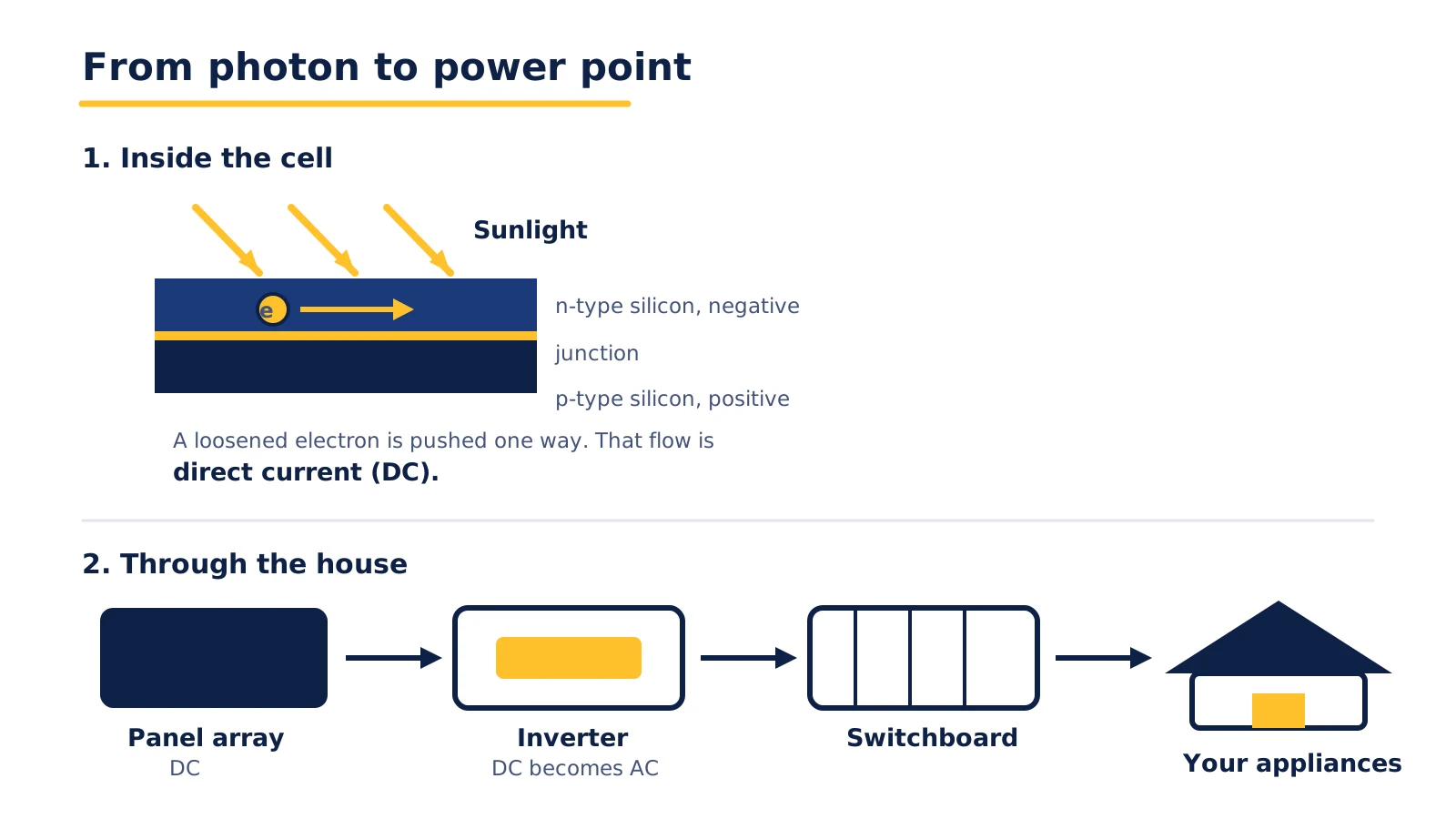
Sunlight carries energy in particles called photons. A solar cell is made of silicon treated so that one side carries a slight positive charge and the other a slight negative charge. When a photon strikes the silicon it knocks an electron loose. The charge difference pushes those loose electrons in one direction, and a flow of electrons in one direction is an electric current.
That is the whole mechanism. It is called the photovoltaic effect, which is where the “PV” in solar PV comes from. No heat is required, which is why panels work on a cold clear day.
Solar panels: how do they work as a complete system?
A single cell produces very little. The useful part is how cells are combined and what happens to the electricity afterwards.
- Cells are wired together into a panel. Typically sixty or more cells behind glass in an aluminium frame, sealed against weather.
- Panels are wired together into an array. Wiring them in series adds up the voltage to a level worth transmitting.
- The array produces direct current. DC flows in one direction. Your house does not run on it.
- An inverter converts DC to alternating current at 230 volts, matched in frequency and phase to the grid.
- The AC feeds your switchboard and powers whatever is switched on.
- Surplus goes to a battery or to the grid, and your meter records what leaves the property.
The inverter is doing the hardest work in that chain. It is also the component with the shortest service life and the one most likely to need replacing before the panels do.
How roof solar panels work differently from other types
The physics is identical everywhere. What changes is mounting, scale and what the electricity is for.
How roof solar panels work
A residential rooftop array is fixed in place at whatever angle your roof happens to be. There is no tracking and no adjustment. That means orientation and pitch are decided for you by the building, which is why a site assessment matters: a north-facing roof generates the most total energy, while an east and west split produces less overall but spreads it across morning and afternoon.
Mounting differs by roof material. Tile, tin and Colorbond each need different brackets and different care, and tile roofs carry a genuine breakage risk that a good installer manages and a cheap one does not.
How solar panel kits work
A solar panel kit is a packaged set of components sold together, usually a few panels, a small inverter or charge controller, cabling and mounting hardware. They are common for sheds, caravans, boats and off-grid cabins.
The important distinction for Australian homeowners: a kit you install yourself cannot be connected to the grid. Grid connection requires a licensed electrician, an accredited installer, network approval and a compliance certificate, and it is a condition of the federal certificate discount. Kits have their place for genuinely standalone, low-voltage applications. They are not a cheaper route to rooftop solar on a house.
How solar panel farms work
A solar farm is the same technology at utility scale: thousands of panels, often ground-mounted on single-axis trackers that follow the sun east to west through the day. Trackers lift output meaningfully but add cost and maintenance, which is why they appear on farms and almost never on houses.
The electricity does not go to a building. It feeds a substation and then the transmission network, and it is sold into the wholesale market. That difference is why solar farm economics have nothing useful to say about household solar economics.
How pool solar panels work
This one causes real confusion, because pool solar panels are usually not photovoltaic at all.
Most pool solar is solar thermal: black polymer tubing or matting on the roof, through which pool water is pumped so the sun heats the water directly. There is no electricity involved anywhere. It is a heating system, not a generating system.
Both can coexist on one roof, and they compete for the same space, so if pool heating is on your wish list raise it before the PV array is designed.
How solar panel cars work
Worth answering because people search it. Panels integrated into a vehicle roof generate a small amount of electricity, enough to contribute modestly to range or to run accessories, but nowhere near enough to be a car’s primary energy source. The available surface area is simply too small.
What is practical today is charging an electric vehicle from a rooftop solar system at home, which is a different proposition and works well when the charging happens during daylight.
How well do solar panels work?
Two measures matter and they get conflated.
Efficiency is the share of the light energy striking the panel that becomes electricity. Modern residential panels convert a meaningful minority of incoming light, and higher efficiency mainly buys you more output from a limited roof area. If you have plenty of roof space, efficiency matters less than price per watt. If your roof is small or cluttered, it matters a lot.
Yield is what you actually get across a year, and it depends on far more than the panel: orientation, tilt, shading, temperature, inverter quality, cable losses, soiling and your network’s export limit.
A high-efficiency panel on a poorly oriented, partly shaded roof with an undersized inverter will underperform a modest panel on a clean, well-designed system. This is why the panel brand is rarely the most important line in a quote.
How long do solar panels work?
Panels degrade rather than fail, declining slowly in output while continuing to work, and they usually outlast the inverter and the isolators around them. Installation quality affects service life at least as much as component quality.
That question deserves more room than it gets here, so we have given it a page of its own: how long do solar panels last covers what actually fails first, what shortens a system’s life in Australian conditions, and what the two warranty types really guarantee.
What this means when you are buying
Three practical conclusions from the way the technology works.
The inverter deserves more attention than it gets. It does the hard work, it fails first, and the quality gap between inverters is wider than the gap between panels.
Design beats components. Orientation, tilt, shading management and correct sizing determine your yield more than the brand on the glass.
Self-consumption is where the money is. Because of how the system works, electricity you use at the moment it is generated avoids the full retail rate you would otherwise pay, while exported electricity earns only a feed-in rate. Shifting dishwashers, pool pumps, hot water and EV charging into daylight hours is free and effective.
Frequently asked questions
How do solar panels work? The simple version
Sunlight knocks electrons loose inside a treated silicon cell. The cell’s built-in charge difference pushes those electrons in one direction, creating a direct current. An inverter converts that to the alternating current your home uses, and the electricity powers your appliances, charges a battery, or is exported to the grid.
How do home solar panels work day to day?
They generate from first light to dusk, peaking around the middle of the day. Your home draws what it needs from that generation first. Any surplus charges a battery if you have one, then exports to the grid. At night you import from the grid or discharge the battery.
How do solar power panels differ from solar hot water panels?
Solar power panels, or PV panels, generate electricity. Solar hot water and pool solar panels heat water directly using the sun’s warmth and generate no electricity at all. They look different up close and do entirely different jobs.
How do my solar panels work when I am not home?
Exactly the same, but with almost nothing consuming the output. With no battery, most of that generation is exported to the grid at your feed-in rate, which is typically a fraction of what you pay to import. This is the main reason households that are empty during the day get less value from solar than households that are not, and the main argument for either load shifting or storage.
How do PV solar panels work in diffuse light?
They still generate, because they respond to light rather than direct sunshine. Output is lower under cloud but rarely zero in daylight. We have covered this in detail in our article on whether solar panels work on cloudy days and in winter.
Do solar panels work without an inverter?
Not for a normal home. The panels produce DC and household appliances need AC, so an inverter is essential in a grid-connected system. Some small off-grid setups run DC loads directly, but that is a specialist case.
Does one shaded panel affect the whole array?
It can, depending on design. Panels wired in a series string are limited by the weakest panel in that string, which is why shaded roofs are often better served by microinverters or optimisers. This should be identified at the design stage, not discovered afterwards.
On that diffuse-light question, the detail is in do solar panels work on cloudy days and in winter.
Where to go next
Once you understand how solar panels work, the next useful question is how big your system should be, because that follows from your consumption rather than from the technology.
Work that out with our solar and battery savings calculator, which takes your state and your actual bill and returns indicative system options. For the broader picture, including costs, batteries and choosing an installer, see our guide to solar power in Australia, or go straight to residential solar.
Sources
- Australian Government Solar Consumer Guide: solar
- Australian Government: Solar PV and batteries
- Clean Energy Regulator: small-scale renewable energy scheme