
Monocrystalline vs polycrystalline is the first specification question most people hit when they start comparing solar quotes. Here is the short version: monocrystalline is more efficient, handles heat slightly better, costs a little more per panel, and is what almost every Australian residential quote now specifies anyway.
The longer version is more interesting, because the monocrystalline vs polycrystalline comparison has quietly stopped being a real decision for most buyers. Understanding why tells you what to actually ask about instead. If you are assessing solar panel options for an Australian roof, that redirection is the useful part.
No prices or efficiency percentages are invented here. Where a figure matters, we tell you which document to read.
Monocrystalline vs polycrystalline at a glance
| Monocrystalline | Polycrystalline | |
|---|---|---|
| Silicon structure | Single continuous crystal | Many crystal fragments fused |
| Appearance | Uniform black or very dark | Blue, visibly speckled |
| Efficiency | Higher | Lower |
| Output per square metre | More | Less |
| Heat tolerance | Slightly better temperature coefficient | Slightly worse |
| Low-light behaviour | Marginally better | Marginally worse |
| Cost per panel | Higher | Lower |
| Cost per watt installed | Now very close | Now very close |
| Availability in Australian residential | Dominant | Largely withdrawn |
The last row is the one that matters most and the one almost no comparison article mentions.
How monocrystalline and polycrystalline silicon solar panels are made
The difference starts in the factory and everything else follows from it.
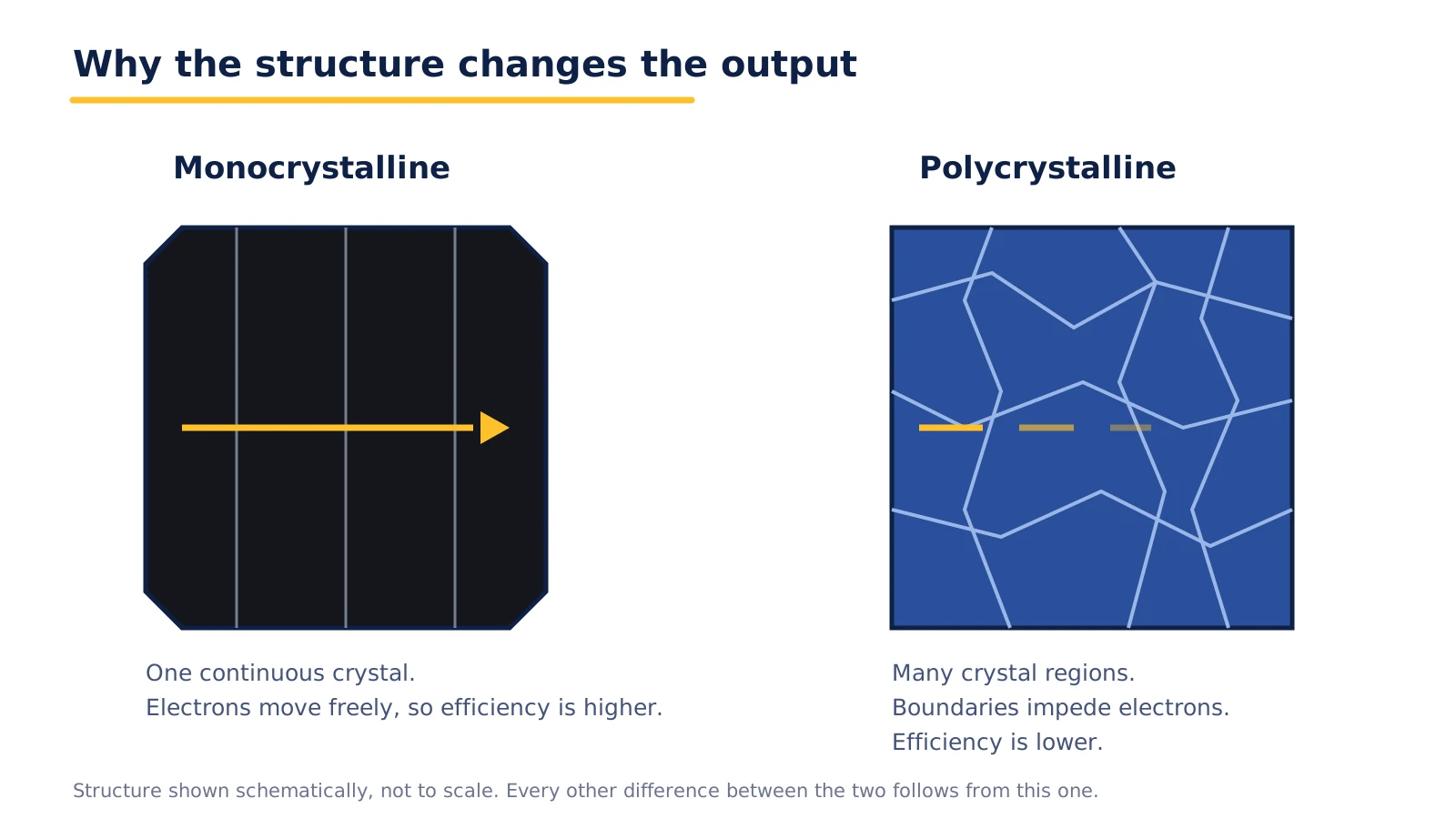
Monocrystalline cells are cut from a single large silicon crystal, grown slowly as one continuous structure. Because the crystal lattice is uniform, electrons move through it with less resistance, which is the root cause of the higher efficiency. The corners of each cell are usually clipped, which is why a mono panel often shows small diamond gaps between cells.
Polycrystalline cells are made by melting silicon fragments and casting them into a block, which cools into many separate crystal regions. The boundaries between those regions impede electron movement slightly, which is why efficiency is lower. The visible blue speckle is those crystal boundaries catching the light.
Mono is more expensive to manufacture because growing a single crystal is slower and wastes more silicon. Poly was developed as the cheaper alternative, and for roughly two decades that trade-off was the whole story.
Monocrystalline solar cells vs polycrystalline: what the difference actually costs you
Four practical consequences.
Efficiency and roof space
Higher efficiency means more watts from the same physical area. This matters only if your roof area is the binding constraint.
If you have a large unshaded roof and want 10 kW, you can reach it with either technology; mono just uses fewer square metres. If you have a small, cluttered or partly shaded roof and want to fit as much capacity as possible, higher efficiency directly buys you more system.
That is the honest rule: efficiency is valuable in proportion to how short of roof space you are.
Temperature performance
Every panel loses output as it heats up, described by its temperature coefficient. Monocrystalline panels generally have a slightly better coefficient, meaning they lose marginally less output per degree.
In Adelaide, where rooftop panel temperatures on a 40 degree day go well above the air temperature, this is a real if modest advantage. It is also one of the few places where the mono advantage compounds over a system’s life rather than just appearing on a spec sheet.
Low light
Monocrystalline performs marginally better in diffuse light. The effect is small and easily overstated by marketing. It does not change whether solar suits your site, and it does not meaningfully alter winter generation, which is driven far more by day length and sun angle. We cover that in do solar panels work on cloudy days and in winter.
Degradation
Both technologies degrade slowly. Published degradation rates have converged substantially, and the figures that matter are in the specific manufacturer’s performance warranty rather than in a generic technology comparison. We go into lifespan in how long do solar panels last.
Monocrystalline vs polycrystalline price
This is where the comparison has changed most, and where old articles mislead.
Per panel, mono still costs more to make and sells for more. That part has not changed.
Per watt installed, the gap has narrowed to the point of near-irrelevance for a residential system. Three reasons:
- Mono manufacturing scaled up enormously, driving the cost premium down.
- Panels are now a modest share of an installed system’s cost. Labour, racking, the inverter, compliance and metering make up much of the total, and none of those change with cell type.
- Higher efficiency reduces the other costs. Fewer panels for the same capacity means less racking, fewer mounting points and less labour, which offsets part of the premium.
The practical consequence: on a modern residential quote, choosing poly to save money saves very little, and it costs you roof space and a little heat performance. That is why the market moved.
Be sceptical of any quote that leans on polycrystalline as a cost saving. The saving is small, and it raises the question of what else in that quote is being specified down.
Solar monocrystalline vs polycrystalline: which should you choose?
For almost every Australian residential installation in 2026, monocrystalline, for three reasons that have nothing to do with marketing:
- It is what is actually available and supported in the residential market.
- The cost premium per watt installed is now small.
- The efficiency and heat advantages are real, if modest, and they compound over decades.
Polycrystalline now turns up mainly as existing installed stock and as second-hand or salvaged panels, which is relevant if you are putting something cheap on a shed or an outbuilding where the compliance requirements differ from a grid-connected house. Some remote and agricultural applications also work with whatever is locally available and serviceable, because replaceability can matter more than efficiency when the nearest supplier is hours away.
None of those describe a suburban rooftop in Adelaide or Sydney, which is the situation most people reading this are in.
Why this comparison matters less than it used to
The shift has been dramatic. SolarQuotes, the long-running independent Australian solar consumer site, notes that around three-quarters of the panels going onto Australian roofs in 2010 were polysilicon, and that they have since disappeared not just from rooftop solar but from solar generally, with monocrystalline now almost the only type going onto Australian roofs.
Manufacturers shifted production to monocrystalline, and newer cell architectures built on mono wafers have moved the industry further in that direction.
So if you are reading a comparison article that treats this as a live 50-50 choice, it is describing a market from well over a decade ago.
What has replaced it as the real decision is which monocrystalline panel, and that question is about the manufacturer, the warranty terms, the temperature coefficient, the degradation curve and whether the brand will still be around to honour a claim. Those differences between two mono panels are now larger than the old mono-versus-poly gap.
For the broader picture on sizing, components and costs, see our guide to solar power in Australia.
What replaced the choice: the mono panels are not all the same
Once you accept that monocrystalline is the answer, a second question opens up, and it is the one worth your attention.
Modern monocrystalline panels are built on different cell architectures. You will see terms like PERC, N-type and TOPCon on datasheets. Without going into the physics, they differ in how the rear of the cell is constructed and how the silicon is doped, and the practical consequences are the ones you care about: slightly different efficiency, slightly different temperature coefficients, and different degradation curves, particularly in the first year.
The important point is proportion. The spread between two monocrystalline panels from different manufacturers and architectures is now wider than the old gap between mono and poly ever was. So a buyer who spends an hour deciding mono versus poly and then accepts whatever mono panel is on the quote has optimised the wrong decision.
A fuller survey of panel technologies, including thin-film and bifacial options that sit outside this two-way comparison, belongs with our types-of-panels content rather than here.
PV panels: monocrystalline vs polycrystalline, and what to ask instead
If the cell type is largely settled, here is what to interrogate on a quote instead.
The exact model number, not “tier 1” or “premium”. Tier 1 describes a manufacturer’s bankability to lenders, not panel quality, and it is widely misused in sales material.
The temperature coefficient, which matters more in Australian conditions than a small efficiency difference.
Both warranty terms, product and performance, read from the actual document rather than the brochure.
The inverter, which has a wider quality spread than the panels and usually fails first.
The racking specification, especially near the coast.
Who installs it, because installation quality determines lifespan more than cell type does.
Frequently asked questions
What is the main difference between monocrystalline and polycrystalline cells?
Monocrystalline cells are cut from a single continuous silicon crystal, so electrons move through them with less resistance and efficiency is higher. Polycrystalline cells are cast from many silicon fragments, and the boundaries between those crystal regions reduce efficiency slightly. That structural difference causes every other difference between them.
Is monocrystalline worth the extra cost?
On a residential system, generally yes, because the premium per watt installed is now small while the efficiency and heat advantages are real. The benefit is largest if your roof area is limited, since higher efficiency means more capacity in the same space.
Which performs better in Australian heat?
Monocrystalline, slightly, because it usually has a better temperature coefficient and therefore loses marginally less output as panel temperature rises. The difference is modest but it applies every hot day for the life of the system.
Can I tell them apart by looking?
Usually. Monocrystalline panels are uniform black or very dark, often with small diamond-shaped gaps between cells where the corners have been clipped. Polycrystalline panels are blue with a visible speckled or shattered-glass pattern.
Can I mix monocrystalline and polycrystalline panels on one roof?
Not within the same string, because panels wired in series are limited by the weakest in that string and mismatched electrical characteristics cause losses. Separate strings with separate inverter inputs, or microinverters, can handle mixed arrays, but it is a design decision rather than something to improvise.
Do monocrystalline panels last longer?
Not inherently. Both degrade slowly and published rates have converged. Lifespan is determined far more by component quality, installation workmanship and site conditions than by cell type.
Is polycrystalline still sold in Australia?
Not in any meaningful way for residential rooftops. Manufacturers shifted production to monocrystalline and poly has effectively disappeared from the Australian market. You may still encounter it as existing installed stock or as second-hand panels, but it is no longer a mainstream option on a new quote.
Does cell type affect my rebate or export limit?
No. The federal certificate discount is based on system capacity and the battery’s usable capacity, and your export limit is set by your distribution network. Neither depends on whether the cells are mono or poly.
Where to go next
The useful takeaway is that this decision has largely been made for you, and the energy you were about to spend comparing cell types is better spent comparing inverters, warranty terms and installers.
Work out what size system your consumption justifies with our solar and battery savings calculator. When you are ready to compare specifications properly, compare your real options with a free ULS quote and we will give you model numbers and datasheets rather than tier claims. System options are on residential solar.
Sources
- Australian Government Solar Consumer Guide: solar
- Australian Government: Solar PV and batteries
- Clean Energy Council: approved products
- Clean Energy Regulator: small-scale renewable energy scheme
- SolarQuotes: mono versus poly panels in Australia