
Is solar worth it in Australia in 2026? For most Australian households, yes. For some, honestly no, and anyone who tells you otherwise is selling rather than advising.
The answer depends on five things about your own house, and none of them are the brand of panel. This article walks through all five so you can work out which group you are in before you spend money. If you are weighing up rooftop solar and battery options for an Australian home, this is the question to settle first.
No prices or payback figures are invented here. Where a number depends on your situation, we say so and show you how to find yours.
The short answer
Solar is worth it when you can use a decent share of what you generate, your electricity rate is high, and your roof is reasonable. It is marginal when you are out all day, on a low rate, with a shaded or awkward roof and a tight export limit.
That is the whole test. Everything below is detail on how to apply it.
The five things that actually decide it
1. When you use electricity
This is the single biggest factor and it is the one most buyers never get asked about.
Electricity you use at the moment it is generated saves you your full retail rate. Electricity you export earns a feed-in rate, which is typically a fraction of that. So two identical systems on identical roofs produce very different outcomes depending on whether anyone is home.
A household with someone there during the day, or with a pool pump, ducted air conditioning or electric hot water running at midday, consumes a large share of its own generation. A household empty from 8am to 6pm exports most of it cheaply.
If you are in the second group, solar still works, but you need to either shift loads into daylight hours or add storage. Doing neither is how people end up disappointed.
2. What you pay per kilowatt-hour
The higher your import rate, the more each self-consumed kilowatt-hour is worth, and the faster the system pays back.
This is why rising electricity prices strengthen the case for solar rather than weakening it, and why a household on a cheap legacy plan sees a slower return than a neighbour on an expensive one. Find your own rate on your bill rather than assuming an average.
3. Your roof
Orientation, pitch, shading and usable area. North-facing maximises total generation; east and west spreads it across morning and afternoon, which can actually suit a household that uses power at both ends of the day.
Shading is the most common reason a system underperforms its quote. A single tree or a neighbouring build can be managed with microinverters or optimisers, but it has to be identified at design stage, not discovered later.
4. Your export limit
Your distribution network caps how much you can send to the grid. In South Australia that is SA Power Networks; in New South Wales it is Ausgrid, Endeavour Energy or Essential Energy depending on your address. Generation above that cap is curtailed and earns nothing.
On a tight fixed limit, a large array designed around exporting is partly wasted. On flexible exports, the picture is much better. This is worth confirming before you size a system.
5. How long you are staying
Payback assumes you remain the beneficiary. If you are likely to sell within a couple of years, the relevant question changes from payback to what solar does for the property’s appeal and value, which is a different analysis with less certain numbers.
When is solar worth it, specifically?
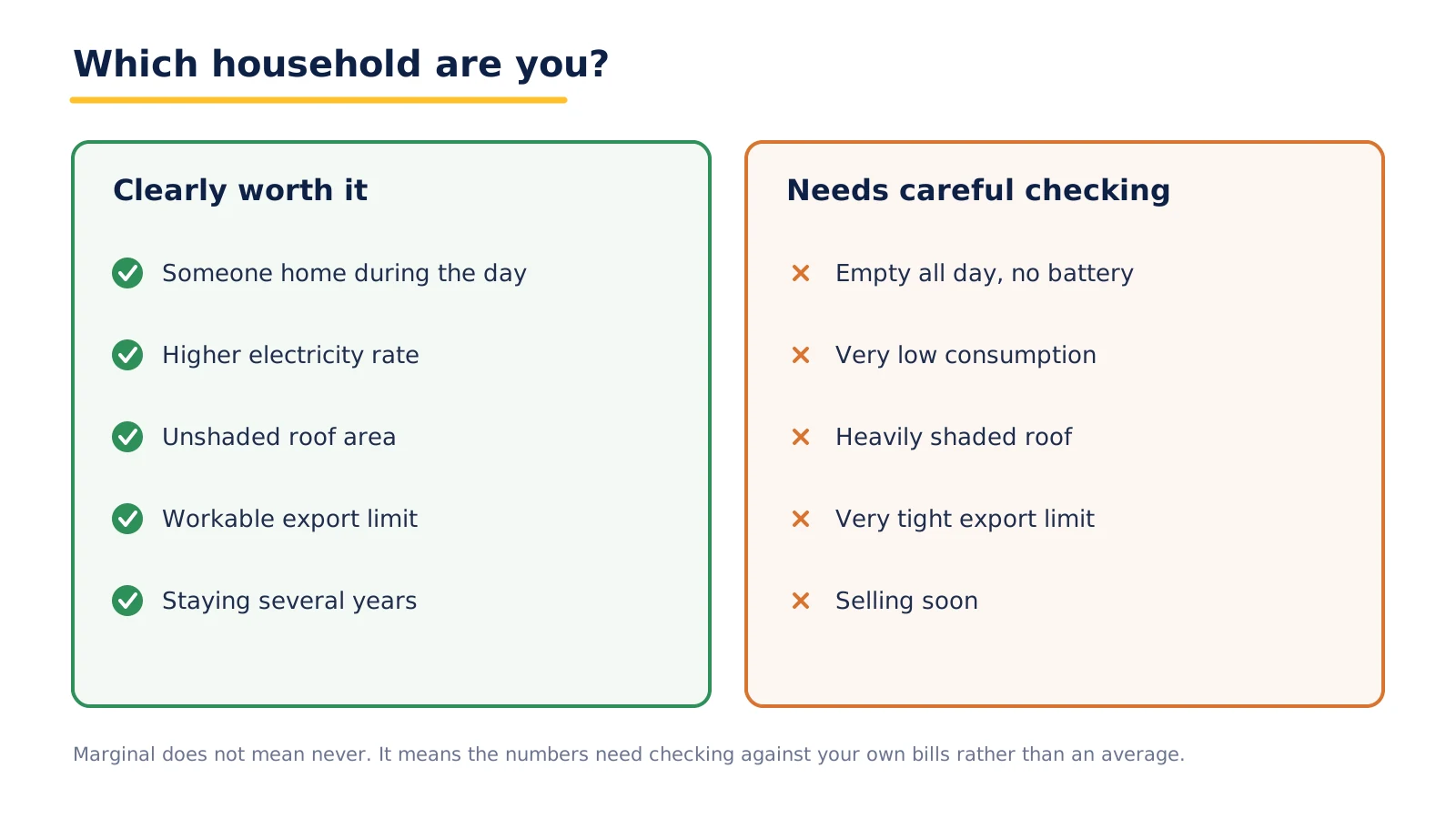
Taking those five together, solar tends to be clearly worth it when:
- Someone is home during the day, or you can shift large loads into daylight.
- You have a decent electricity rate and reasonable consumption.
- Your roof has unshaded area facing north, east or west.
- You can access flexible exports or a workable export limit.
- You intend to stay several years.
It tends to be marginal when:
- The house is empty all day, there is no battery, and no loads can be shifted.
- Consumption is very low, so there is little bill to offset.
- The roof is heavily shaded, very small, or structurally difficult.
- You are on a 0 kW or very low export limit with no storage.
- You are selling soon.
Marginal does not mean never. It means the numbers need checking properly rather than assuming.
Is solar really worth it, or is that just the sales pitch?
A fair question, and worth separating into the parts that are solid and the parts that get oversold.
Solid: the generation is real and predictable within a seasonal range. The saving on electricity you no longer buy is real and is the main return. The federal certificate discount is real and reduces the upfront cost.
Oversold: payback periods quoted without anyone asking for your consumption data. Savings estimates that assume you consume 70% of your generation when nobody has checked. Forecasts built on steep annual electricity price rises. Export revenue presented as a major contributor when feed-in rates have fallen substantially.
The test for any quote: did they ask for twelve months of bills before giving you a number? If not, the number is an average wearing a disguise.
Is going solar really worth it with feed-in tariffs this low?
Feed-in rates have fallen as rooftop solar has grown and midday wholesale electricity has become abundant. That is a structural change, not a dip.
It changes the strategy rather than the verdict. Low feed-in rates make self-consumption the priority and strengthen the case for a battery, because energy you keep is worth far more than energy you sell. What it does not do is make solar pointless, because the main return was never the export revenue.
We have set out the storage comparison in solar battery or feed-in tariff, which is better.
Is it worth having solar panels without a battery?
For most Australian households, yes, and most installed systems have no battery.
A battery improves the outcome where evening consumption is high and your feed-in rate is low, but it adds cost and in simple payback terms usually lengthens the period rather than shortening it. Solar without storage remains the lower-risk starting point, and a battery can be added later if the system is specified with that in mind. We have covered the retrofit question in can you add a battery to an existing solar system.
Is home solar worth it versus other ways to cut your bill?
Worth asking honestly, because solar is not always the best first dollar.
Cheaper moves that often come first: switching to a better electricity plan, fixing draughts and insulation, replacing an old electric hot water system, and moving heavy loads off peak periods. None of them are as satisfying as panels on a roof and several have shorter payback.
Solar’s advantage is that it keeps working for decades and gets better as electricity prices rise. The sensible sequence for most households is to take the cheap efficiency wins, then install solar sized to the consumption that remains.
Is solar PV worth it for a business?
Different arithmetic, usually better. A business operating through the middle of the day can self-consume almost everything it generates, which is the ideal profile. Demand charges, tariff structure and depreciation treatment matter more than feed-in rates.
If that is your situation, start with commercial solar rather than residential modelling.
“Solar is not worth it”, and where that view comes from
It is worth taking the objection seriously, because people who say it usually have a reason.
They were sold the wrong system. Oversized for export on a low feed-in rate, or undersized to hit a price point.
Nobody checked their consumption pattern. An empty-all-day household with no battery and no load shifting will underperform a generic estimate.
The install was poor. Shading ignored, cheap inverter, undersized cable, a failed isolator. These are workmanship problems rather than technology problems.
They compared against a quote, not against reality. If the original number was inflated, real performance looks like failure even when the system is fine.
Their circumstances genuinely do not suit it. A small shaded roof, low consumption and a 0 kW export limit is a real case where the honest answer is no.
If you already have solar and it is not performing, the cause is usually identifiable. We have worked through the common ones in five reasons your solar panels are not saving you as much as expected.
How to get your own answer rather than ours
Four steps, in order:
- Get twelve months of bills. You need daily kilowatt-hours and your usage rate, not an estimate.
- Work out your daytime share. Roughly how much of your consumption happens between 9am and 4pm.
- Check your roof and your export limit. Both constrain what is possible before any brand decision.
- Model it, then stress-test it. Run the numbers, then run them again with every assumption 20% worse. If it still works, it works.
Our solar and battery savings calculator does the first pass from your state and your actual bill amount.
Frequently asked questions
Is getting solar power worth it in Australia?
For most households, yes, because the main return is the grid electricity you stop buying and Australian electricity rates are high relative to system costs. It is marginal where the home is empty all day with no battery, consumption is very low, the roof is heavily shaded, or the export limit is very tight.
Is solar power worth it if I am not home during the day?
It can be, but not on default settings. You either shift large loads such as hot water, pool pumps and EV charging into daylight hours, or you add storage. Doing neither means exporting most of your generation at a low feed-in rate, which is the weakest version of the deal.
Are solar panels worth it with feed-in tariffs so low?
Yes, because exports were never the main return. Low feed-in rates shift the priority to using your own generation and make a battery more attractive. They do not undermine the core saving, which is the electricity you no longer import.
Is it worth getting solar if I might move house?
If you are selling within a year or two, payback is the wrong measure, because you will not be there to collect it. The question becomes what the system does for the property’s value and appeal, which is less certain. If you plan to stay several years, payback is the right lens.
Is solar hot water worth it as well as solar panels?
They are different products competing for the same roof. Solar hot water or a heat pump heats water directly and can be very efficient, while solar panels generate electricity you can use for anything including hot water. Which combination suits you depends on your existing hot water system and your roof area, so raise it before the panel layout is designed.
Is it worth installing solar panels on a shaded roof?
Sometimes, with the right design. Microinverters or optimisers reduce the impact of partial shading, and the shaded portion of the roof can simply be left clear. What matters is that the shading is assessed properly at design stage rather than discovered in your first winter.
How many panels do I need for solar to be worth it?
There is no minimum. What matters is matching system size to your consumption and your daytime usage share. Very small systems tend to offer poor value per kilowatt because the fixed costs of compliance, metering and labour are much the same whatever the array size.
Will solar add value to my home?
Australian property research generally points to a positive effect, but it varies by market and by system age and quality. Treat it as a secondary benefit rather than part of the payback calculation.
Where to go next
The honest position is that nobody can tell you whether solar is worth it without your consumption data. Anyone who gives you a payback figure before seeing twelve months of bills is guessing.
Get an indicative answer in a minute with our solar and battery savings calculator. When you want it checked properly, compare your real options with a free ULS quote and we will build the numbers from your actual usage, roof and export limit rather than an average. System options are on residential solar, and the broader picture is in our guide to solar power in Australia.
Sources
- Australian Government Solar Consumer Guide: solar
- Australian Government: Solar PV and batteries
- Australian Government: Energy Made Easy
- Australian Competition and Consumer Commission: consumer guarantees