

The Solar Sharer Offer 2026 can help some households save, but only if they can move enough electricity use into three free midday hours each day. For a battery owner, free grid electricity during that window is a different benefit from the savings a battery delivers by storing your own solar, and the two need to be assessed separately.
The offer started on 1 July 2026 in New South Wales, South Australia and South East Queensland. It matters to anyone with solar panel and battery systems in Adelaide and Sydney or planning one, because a midday free window may suit a battery that can be scheduled to charge at that time. Whether it actually saves you money depends on your battery, your plan, your solar exports and your daily routine.
What Is the Solar Sharer Offer 2026?
The Solar Sharer Offer (SSO) is a regulated, opt-in electricity plan that gives eligible households three hours of free electricity in the middle of the day. According to the Australian Government’s energy.gov.au Solar Sharer Offer page, it became available on 1 July 2026 to eligible households in Default Market Offer areas: New South Wales, South Australia and South East Queensland.
It was introduced as part of the Default Market Offer (DMO) reforms. The Australian Energy Regulator (AER) sets the main tariff settings, including the free period, the daily supply charge and the usage rates that apply outside the free window.
Eligibility for the Solar Sharer Offer 2026, as described by Energy Made Easy:
- You are a residential customer in a DMO region.
- You have a smart (interval) meter.
- You are not supplied through an embedded network, such as some caravan parks, retirement villages and apartment blocks.
- Your retailer offers the SSO. Retailers with more than 1,000 customers across DMO regions must offer it, and some very small retailers are exempt.
You do not need rooftop solar, and both owners and renters can take it up. It is opt-in, so your retailer will not move you onto it automatically.
The most important point is that free electricity during the window does not mean a free electricity bill. You still pay a daily supply charge, any controlled load usage, and the rates for every kilowatt-hour used outside the window.
When Is Electricity Free Under the Solar Sharer Offer?
The free period is three consecutive hours at the same time every day, all year. Energy Made Easy states that the times do not change with daylight saving.
| Region | Free-use window | Eligibility notes |
|---|---|---|
| New South Wales | 11 am to 2 pm | Smart meter required, opt-in, residential customers only |
| South Australia | 12 pm to 3 pm | Smart meter required, opt-in, residential customers only |
| South East Queensland | 11 am to 2 pm | Same conditions; outside UR Local Solar’s service areas |
Source: Energy Made Easy and energy.gov.au, 2026.
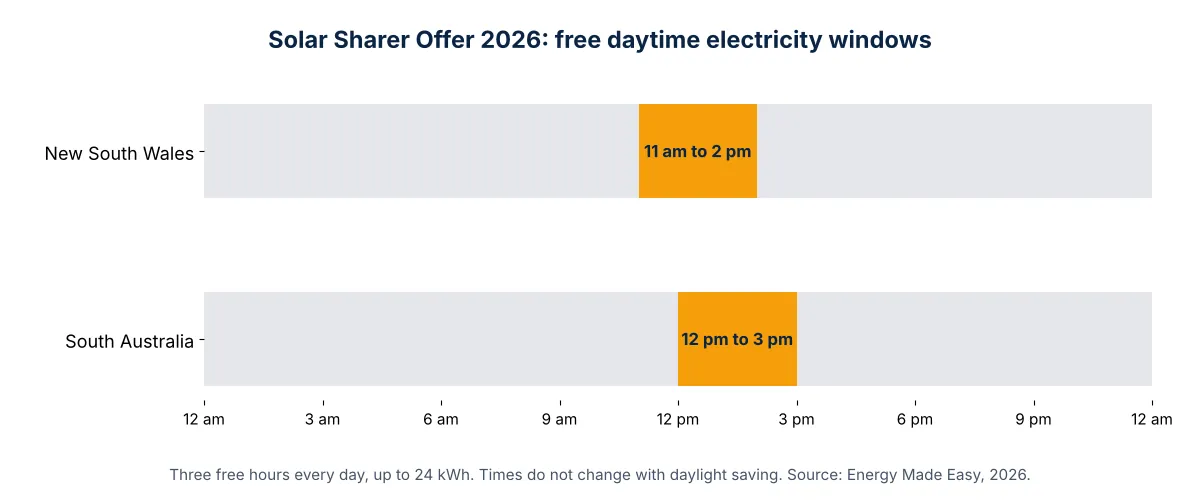
There is a daily reasonable use limit. Energy Made Easy explains that the first 24 kWh used during the free window is free, which it describes as about what a five-person household uses across a whole day on average. Usage above that limit is charged at the off-peak or solar soak rate that applies outside the free period.
Retailers may apply the limit in slightly different ways. For example, one major retailer says its cap is averaged across the billing period rather than applied strictly day by day. Check the plan documents for your retailer.
Outside the window, electricity is charged at time-of-use rates. The Australian Government’s regulatory explainer states that the cost of the free period is recovered by lifting non-free usage charges by 1 to 4 cents per kWh, depending on the region. That is why comparing the whole plan matters more than the free-hours headline.
Can You Charge a Solar Battery With Free Daytime Electricity?
Sometimes, but it is not automatic. Energy.gov.au lists charging a home battery during the free period as one way to use the offer, if you have a battery. Whether your system can do this, and whether it makes financial sense, depends on several things.
Grid charging and solar charging are different. Charging from surplus rooftop solar uses energy your panels produced. Charging from the grid during the free window uses electricity supplied by your retailer, which is free only within the usage limit. A battery that fills from solar by midday may have little room left for grid charging.
Points to check with your installer before relying on the free window:
- Scheduled grid charging. Not every battery or energy management system supports charging from the grid on a timer. Some products restrict it by operating mode or by settings that only an installer can change.
- Charging power and capacity. A battery’s maximum charge rate and usable capacity determine how much it can take in three hours.
- State of charge. If the battery is already partly full, it will draw less from the grid.
- Household load. Your home still uses electricity during the window. Battery charging plus household use counts toward the same usage limit.
- Manual management. An energy retailer has noted that the SSO is a general plan and does not manage or optimise your battery, so you may need to set the charging schedule yourself.
- Compliance and warranty. Changes to battery settings should be made by a qualified installer, and you should confirm the manufacturer allows scheduled grid charging.
A compatible battery set up to charge during the window can store electricity for the evening, when time-of-use rates are usually higher. That is the opportunity. The cost side is covered in the sections below.
Solar Sharer Offer 2026 With Solar Panels and a Battery
If your home already generates solar electricity, your panels and the free window are working in the same hours. In practice, your system may already cover much of your midday use, which leaves less grid electricity to be “free”.
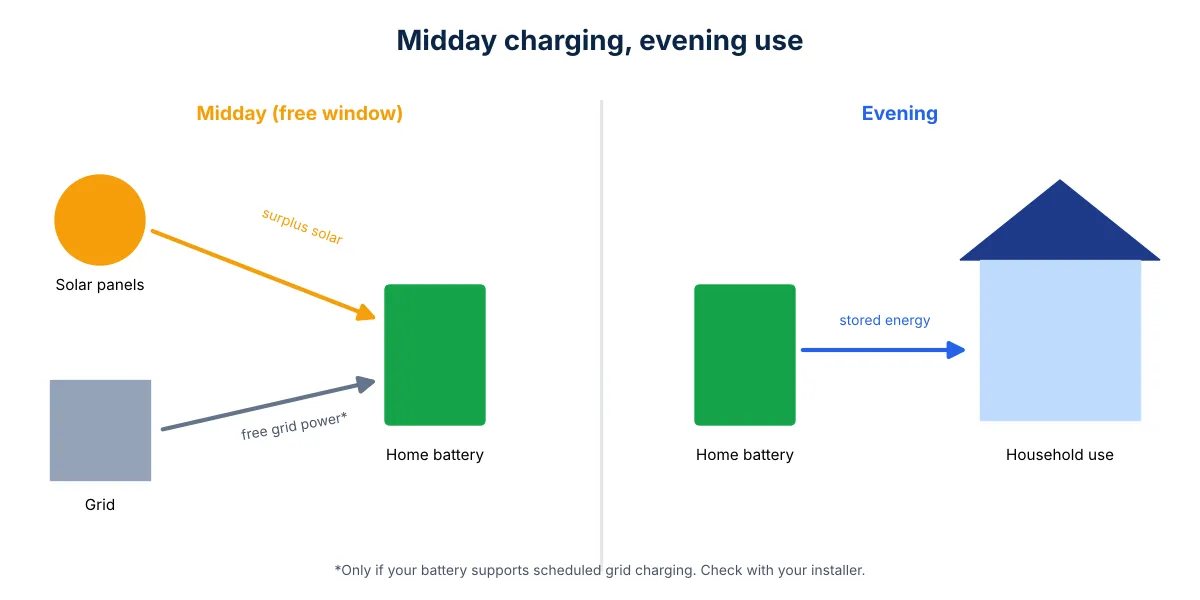
A typical sunny-day sequence for a home with solar and a battery looks like this:
- Solar powers the household directly.
- Surplus solar charges the battery.
- Once the battery is full, remaining surplus is exported to the grid and earns a feed-in credit, if your plan pays one.
- If scheduled and supported, the battery may draw free grid electricity during the window when solar is not enough to fill it.
- In the evening, the battery supplies the home instead of buying peak-rate electricity.
Free grid electricity is not automatically more valuable than your own surplus solar. Your solar energy has a value, either what a feed-in tariff pays or what it saves when used at home later. Using grid power to fill the battery instead leaves more solar to be exported, so you earn feed-in credit only if your plan pays one.
That brings your existing plan into the picture. Feed-in tariffs differ between retailers and between plans, and a plan that pays less or nothing for exports changes the maths. Our guide to solar battery or feed-in tariff for homes in SA and NSW explains how to weigh those two options.
Do not assume that free grid charging and solar charging can be combined perfectly. Inverter limits, battery settings and the timing of cloud and load all affect the result.
Could Free Electricity Reduce Your Battery Running Costs?
It can reduce the cost of charging the battery under the right conditions, but it does not guarantee a lower total bill. The financial mechanisms to weigh are:
- Cost of charging electricity. Grid electricity used within the free usage limit costs nothing per kWh during the window. Electricity above the limit is charged.
- Value of solar you would otherwise export. If grid charging displaces solar that would have been exported and credited, that lost credit is a real cost.
- Round-trip efficiency. Some energy is lost between charging and discharging, so you get back less than you put in. Check the specification for your battery.
- Rates outside the free window. Under the SSO, non-free periods carry time-of-use rates that include the recovered cost of the free hours.
- Value of stored energy. Electricity discharged in the evening is worth what you would otherwise have paid at that time of day on your plan.
- Daily supply charge. This applies on every plan, regardless of how much you use.
- Tariff restrictions. Controlled load circuits are charged separately and do not benefit from the free period.
So a battery may be cheaper to charge, yet the household bill can still rise if evening, morning or export rates are less favourable than on your current plan.
Is the Solar Sharer Offer Better Than a Standard Electricity Plan?
Sometimes, and sometimes not. Energy Made Easy advises comparing the whole plan, not the free power headline. Use the table below as a checklist, filling in each row from the rate card of each plan you are comparing.
| What to compare | Solar Sharer Offer | Your current or alternative plan |
|---|---|---|
| Free electricity window | Three hours daily, up to the usage limit | Usually none |
| Usage rates outside the window | Time-of-use rates set by the plan | Check the rate card |
| Daily supply charge | Applies | Applies |
| Feed-in tariff | Varies by retailer and plan | Check the rate card |
| Free-use limit and excess rate | 24 kWh, with excess charged at the off-peak or solar soak rate | Not applicable |
| Fit with battery charging strategy | Depends on whether your battery can charge from the grid on a schedule | Depends on the plan |
| Fit with daily routine | Best if you can use more electricity at midday | Depends on your usage |
Energy Made Easy also notes that retailers may offer other plans with a discount or free period during the day, so the SSO is not the only option. Compare plans on Energy Made Easy using your own meter data where possible. Do not assume the Solar Sharer Offer 2026 is the cheapest option for your household.
Who Could Benefit Most From the Solar Sharer Offer?
The offer rewards flexibility. Energy.gov.au says the more electricity use you can shift into the free window, the more you could save. Different households sit in different places:
- Homes with a solar battery. A battery that can charge from the grid on a schedule may capture the window without you being home. The benefit depends on how much your solar already fills the battery and what your export plan pays.
- Homes with rooftop solar only. Your panels may already cover much of the window. Industry commentary suggests homes with decent-sized solar and no battery often use little grid electricity at midday, so the offer may add little.
- Homes without rooftop solar. These households can benefit most directly if they can run appliances, heating, cooling or an electric vehicle charger during the window.
- Homes with high evening use. If most of your consumption falls in the evening, a battery is what moves midday energy into that period. Without one, evening usage is charged at non-free rates.
- Homes that cannot shift use. If most of your consumption is in the morning and evening and you have no battery, the offer may not suit you, according to Energy Made Easy.
The offer is not limited to battery owners. In this guide we focus on how it interacts with battery storage.
When Might the Solar Sharer Offer Not Save You More?
A free period does not guarantee a lower bill. The offer may fall short when:
- Rates outside the free window are higher than on your current plan.
- The daily supply charge is higher.
- You cannot shift much usage to midday.
- You use more than the free-use limit, so the excess is charged.
- Your battery cannot be scheduled to charge from the grid, or the manufacturer restricts it.
- Grid charging reduces solar exports and your plan’s feed-in credit is lost or reduced.
- Your existing plan is already cheaper overall.
If your battery already fills from your own solar before or during the window, there may be little left for the free period to discount.
How to Calculate Whether the Offer Works With Your Battery
The reliable method is to compare the expected annual cost on your current plan with the expected annual cost on the Solar Sharer Offer 2026, using your own consumption data. Do not estimate savings by multiplying battery capacity by a retail electricity price. That ignores export value, efficiency and rates outside the window.
Step 1. Gather your data. Use at least 12 months of bills or interval meter data, which shows consumption by time of day. Energy Made Easy can use your NMI to base its comparison on your last 12 months of usage.
Step 2. Record these figures for each plan:
- Electricity imported during the free window, and whether it exceeds the usage limit
- Electricity imported outside the free window, by rate period
- Daily supply charge
- Usage rates for each period
- Solar generation and exports, and the feed-in tariff
- Where the battery is charged from (solar or grid) and its efficiency
- Energy later discharged from the battery, and the rate it replaces
Step 3. Work out the difference:
Annual difference = value of free-window imports + value of battery discharge at replaced rates, minus extra cost of imports outside the window, minus any supply charge difference, minus lost feed-in credit, minus battery efficiency losses and any excess-use charges.
A positive result suggests the SSO may suit you. A negative result suggests staying put. We have not included a worked dollar example because verified rates differ by retailer, network and plan, and no single set of figures would be accurate for every reader.
Step 4. Test your assumptions. Be realistic about how much usage you can shift. Energy Made Easy cautions against over-estimating it.
How to Make the Most of Free Daytime Electricity
If the numbers work, these steps help:
- Schedule suitable appliances, such as dishwashers, washing machines and clothes dryers, to run during the window, where safe and practical.
- Use timers or smart appliance settings so the schedule runs without you.
- Pre-heat or pre-cool your home during the window to reduce use later, where this suits you.
- Charge an electric vehicle during the window if you have one.
- Ask your installer whether your battery supports scheduled grid charging, and review the manufacturer’s instructions.
- Have a qualified installer make any change to battery settings. Do not attempt electrical modifications yourself.
- Check the effect on your solar exports and feed-in credit before switching.
- Review your actual bills for the first few months after switching and compare them with your expectations.
Hot water systems and pool pumps on a controlled load circuit may not be shiftable and are charged at controlled load rates.
If you are weighing an upgrade, our guides on whether a solar battery is worth it in Australia and adding a battery to an existing solar system cover the wider decision. For the current federal battery program, see our Cheaper Home Batteries Program guide.
Solar Sharer Offer 2026: Key Takeaways
- The Solar Sharer Offer gives eligible households three free midday hours daily, up to a 24 kWh usage limit, in NSW, SA and South East Queensland.
- Free windows are 11 am to 2 pm in NSW and 12 pm to 3 pm in SA, and they do not change with daylight saving.
- You need a smart meter, and you must opt in through a retailer that offers the plan.
- Free daytime electricity is not a free bill. Supply charges and rates outside the window still apply.
- Free grid charging and battery storage savings are two different benefits.
- Not every battery supports scheduled grid charging, so confirm this with your installer.
- Grid charging can reduce solar exports and feed-in credit.
- Compare the full cost of each plan using your own meter data before switching.
Frequently Asked Questions
What is the Solar Sharer Offer in Australia?
The Solar Sharer Offer is a regulated, opt-in electricity plan that began on 1 July 2026. It gives eligible households with a smart meter three free hours of electricity each day, up to 24 kWh, in New South Wales, South Australia and South East Queensland. You still pay supply charges and the rates for electricity used outside the free window.
Can I charge my home battery with free daytime electricity?
Possibly, if your battery and energy management system support scheduled grid charging and you are on an eligible plan. Energy.gov.au lists battery charging as one way to use the window. Support varies between products and settings, so ask your installer before relying on it. Charging from the grid may also reduce solar exports and the feed-in credit you earn.
Does the Solar Sharer Offer work with rooftop solar?
Yes, but you do not need rooftop solar to join. If you have solar, your panels may already cover much of your midday use, which can leave little grid electricity to claim for free. Feed-in tariffs also differ between plans, so compare what each plan pays for exports before switching.
Is the Solar Sharer Offer available in South Australia and NSW?
Yes. The offer is available in the Default Market Offer regions of New South Wales, South Australia and South East Queensland. The free window is 11 am to 2 pm in NSW and 12 pm to 3 pm in South Australia. You must be a residential customer with a smart meter and a participating retailer.
Is the Solar Sharer Offer cheaper than a standard electricity plan?
Not always. Energy Made Easy advises comparing the whole plan, not just the free hours. The cost of the free period is recovered through higher rates outside the window, and supply charges still apply. It tends to suit households that can shift much of their usage to midday. Compare plans using your own consumption data.
Do I need a smart meter to access the Solar Sharer Offer?
Yes. A smart meter, also called an interval meter, is a requirement for the Solar Sharer Offer. If you do not have one, ask your retailer whether one can be installed and whether any fees apply. You also need to be a residential customer, outside an embedded network, with a retailer that offers the plan.
Thinking About a Battery? Talk to UR Local Solar
If you want to know whether a battery suits your home and your electricity plan, our team can discuss battery compatibility, scheduling options and installation across Adelaide and Sydney. Explore our solar battery systems or contact UR Local Solar to arrange a free assessment. Savings depend on your household, your tariff and your usage, and tariffs and eligibility are set by retailers and government, not by us.
Sources: Australian Government, Solar Sharer Offer (energy.gov.au); Energy Made Easy, The Solar Sharer Offer: What you need to know (2026)