

Yes, a solar battery can earn money through a virtual power plant in NSW, but only if the battery is eligible, you join a provider that accepts it and you accept that provider’s terms. The money usually comes as a one-off NSW Government incentive plus ongoing credits or export payments set by the provider, not as a guaranteed income.
A virtual power plant (VPP) links many home batteries so a provider can use part of their stored energy when the grid needs it most. If you already have solar battery installation in Adelaide and Sydney or are planning one, a VPP is worth understanding before you sign anything, because the right offer depends on your battery, your retailer and how much control you are willing to share.
This guide explains how VPPs work, how NSW households are paid, what the NSW Government incentive covers in 2026, and the trade-offs to check before you enrol.
What Is a Virtual Power Plant?
A virtual power plant is a group of home and business batteries that are connected through software and the internet so they can act together like one larger power source. The NSW Government describes VPPs as connected groups of batteries that allow excess stored power to be sold to the grid during times of peak demand. The Australian Energy Market Operator (AEMO) describes a VPP more broadly as an aggregation of generation, storage and controllable loads coordinated to deliver services to the power system and electricity markets.
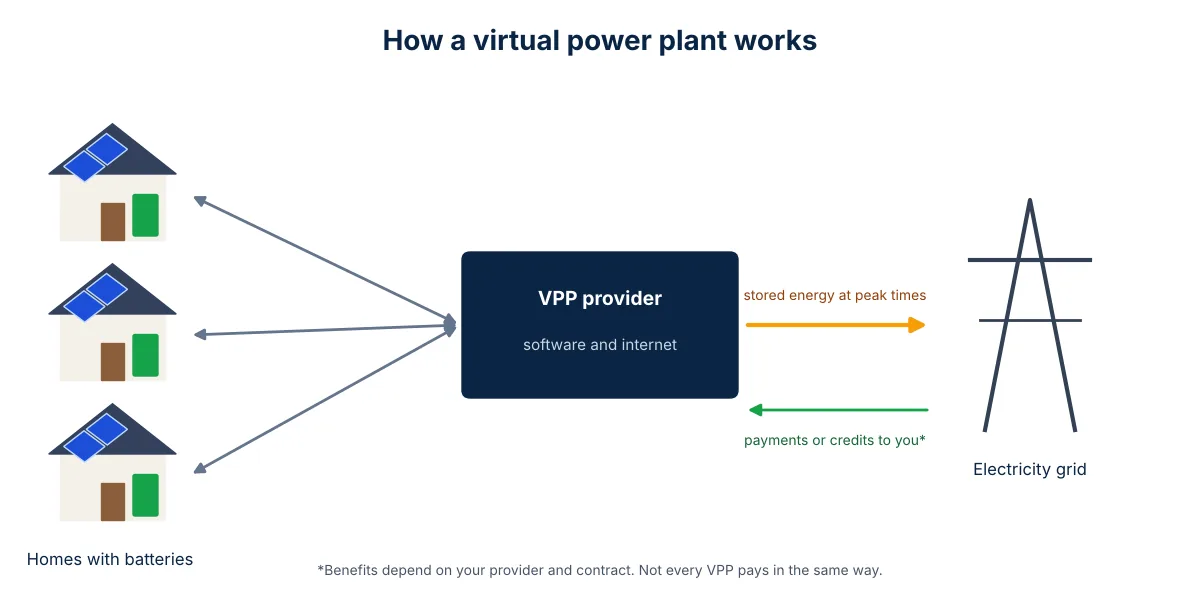
How a VPP differs from other things you may already know:
- An individual home battery stores your solar and powers your home. On its own, it only responds to your household.
- A conventional power station is one large generator in one place. A VPP is spread across hundreds or thousands of homes.
- A standard solar installation exports surplus solar when it is generated. A VPP can also schedule when stored battery energy is exported.
- A retailer’s VPP programme is one company’s commercial offer. Each programme has its own payments, eligible batteries and rules, so two VPPs can work very differently.
How Does a VPP Work With a Solar Battery?
In general terms, joining a virtual power plant follows these steps. The exact process differs between providers.
- You own, or install, a battery that the provider supports.
- You choose a VPP provider and sign its contract and, for the NSW incentive, a nomination form.
- The provider connects to your battery or inverter through the internet and its approved software.
- The provider can then charge or discharge part of your battery’s capacity under the rules in your contract, for example during peak demand or high wholesale prices.
- You receive the benefits set out in your agreement, such as an upfront incentive, bill credits or payments for exported energy.
Not every VPP uses the same level of control. The NSW Government’s VPP page includes a NSW household who says they can choose when to sell power into the grid or leave that decision to their provider. Other programmes give the provider more control. Your contract sets out how much battery capacity the provider can access and when.
Can Your Solar Battery Earn Money in NSW?
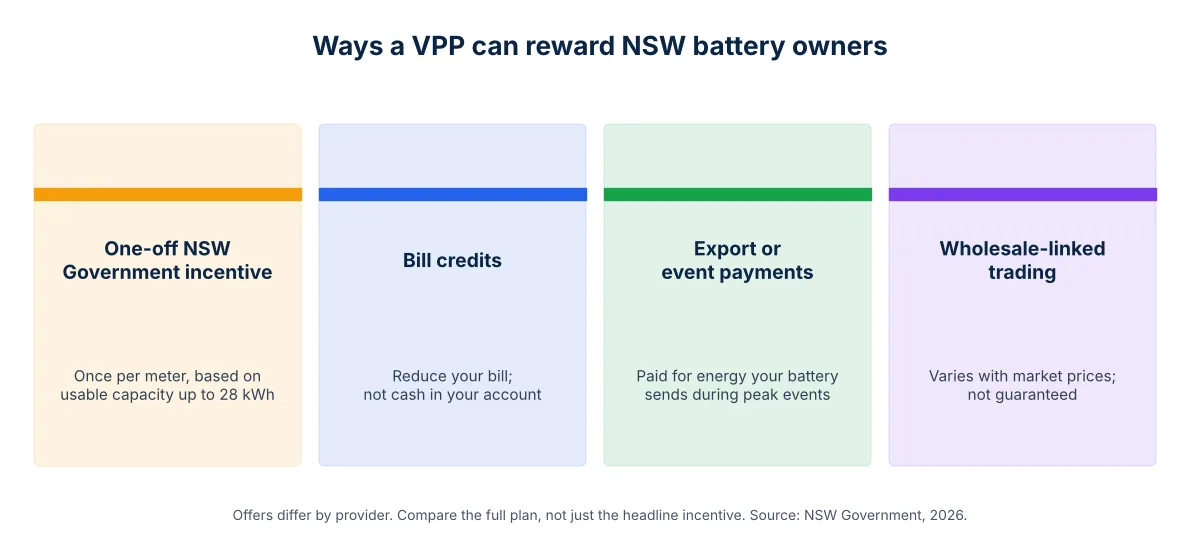
It can, but the type of benefit matters. According to the NSW scheme administrator’s fact sheet for battery VPP incentives, offers can include up-front or sign-up credits, energy bill credits, feed-in tariffs for surplus electricity and payments for ongoing battery use.
These are the main ways NSW households can benefit:
- One-off NSW Government incentive. An upfront payment for connecting an eligible battery to a VPP, funded through the NSW Peak Demand Reduction Scheme. It can be paid in instalments, as an upfront payment or as a credit on your power bill, and can be claimed once per electricity meter (NMI).
- Bill credits. Some providers pay recurring credits. These reduce your electricity bill but are not cash deposited into your bank account.
- Export or event payments. Some providers pay for the energy your battery exports during peak events or price spikes.
- Wholesale-linked trading. Some providers buy and sell at prices linked to the wholesale market. Results vary with market conditions and can be negative in some periods.
- Plan-related value. A VPP may require a specific electricity plan. Changes in usage rates, supply charges or feed-in tariffs can add to, or reduce, the overall benefit.
A bill credit or plan discount is a saving, not income. When you compare offers, separate what you would be paid from what you would save.
How Much Can a VPP Pay Solar Battery Owners?
There is no single answer, because the NSW Government incentive and provider rewards both vary. The NSW Government’s virtual power plant incentive page (updated 31 August 2026) states that the upfront incentive depends on the battery capacity made available to the grid, up to 28 kWh. The actual amount also depends on the provider you choose and the contract you agree to. The page does not publish a fixed dollar amount.
Here is what two current provider pages show. These are examples, not a ranking or a full market comparison.
| Provider | Type of benefit | Advertised amount or mechanism | Payment timing | Battery eligibility | Important conditions | Source and date checked |
|---|---|---|---|---|---|---|
| ActewAGL (NSW customers) | NSW Government VPP incentive, plus an optional bill-credit plan | Indicative one-off incentive examples range from $351 for a 9.7 kWh battery to $906 for a 25 kWh battery. A separate Battery Power Top-Up plan advertises $60 per quarter in bill credits | One-off incentive paid through its certificate provider; credits each quarter | VPP-capable, on the Clean Energy Council approved list, compatible with its VPP, 2 to 50 kWh usable, installed with rooftop solar | NSW residential customers only, joined on or after 13 August 2026, once per meter. The page says amounts are indicative and most batteries receive less than the scheme cap | ActewAGL NSW VPP incentive page, checked 21 Oct 2026 |
| Amber (SmartShift) | NSW Government VPP incentive, plus wholesale-linked battery trading | Up to $1,015, described as an estimated guide for a battery of 28 kWh or larger and not guaranteed. Ongoing results depend on wholesale prices | Incentive confirmed and paid by its certificate provider | Above 2 kWh and up to 50 kWh usable, on the approved list when onboarded, compatible with SmartShift, first-time connection | Requires Amber’s battery plan with SmartShift. Solar not required for batteries onboarded from 1 July 2026 | Amber NSW battery incentive page, checked 21 Oct 2026 |
Advertised maximums suit larger batteries. A smaller battery will usually attract a smaller incentive. Ongoing earnings are not published as fixed amounts by either provider, so we have not estimated them.
For a wider view of bills, CHOICE reported in August 2026 on the ACCC’s electricity inquiry findings that VPP customers recorded some of the lowest annual electricity bills. Those comparisons describe total bills for households that typically also have solar and a battery, so they are not a measure of VPP payments alone.
Which Solar Batteries Can Join a Virtual Power Plant?
The NSW incentive applies to batteries from 2 kWh up to 50 kWh, and from 1 July 2026 batteries up to 50 kWh are eligible. Off-grid batteries cannot join because they are not connected to the grid, and batteries at apartment buildings are not eligible for this incentive.
Meeting the size rule is only the start. Provider eligibility depends on:
- Battery make and model, and whether it is on the provider’s supported list.
- Inverter compatibility, including hybrid or AC-coupled configurations the provider accepts.
- Battery management system and communications, so the provider can monitor and control the battery remotely.
- A stable internet connection, which the scheme administrator lists as a requirement.
- Approved product status, as some providers require the battery to be on the Clean Energy Council approved list.
- Installer commissioning, so the system is set up in a configuration the provider supports.
A battery that is technically capable of remote control is not automatically eligible for every programme. The NSW Government notes that VPP providers choose which battery models they work with, where they operate and what services they offer. If you are still choosing hardware, our solar battery systems page explains the options we install.
What Happens When a Virtual Power Plant Uses Your Battery?
When a virtual power plant dispatches your battery, it discharges some of your stored energy to the grid, usually at times of high demand or high prices. Some providers may also charge your battery from the grid when prices are low.
What to look for in the contract:
- Access window. The times your battery is available to the VPP.
- Capacity share. How much of your battery’s capacity the provider can use.
- Reserve setting. Whether a minimum level of charge is kept for your home, and whether you can change it.
- Charging rules. Whether the provider can charge your battery from the grid, and at what price.
- Your controls. Whether you can opt out of an event or adjust settings in an app.
Because a dispatch event uses stored energy, you may have less available for your own evening use afterwards. Not all VPPs dispatch at the same times or as often, so check how your provider describes its events.
Will Joining a VPP Affect Your Backup Power?
It can. Backup power and virtual power plant services draw on the same stored energy, so a VPP event could leave less charge in the battery if a blackout follows. Whether your home has backup at all depends on the battery, the inverter, how the system was wired and its operating settings. Not every battery installation provides backup power.
Before enrolling, ask the provider:
- Does the programme keep a minimum reserve for my home, and how much?
- Can I raise that reserve, for example before a storm?
- What happens to VPP events during an outage?
We cannot guarantee that a participating battery will keep a set amount of energy or provide whole-home backup during an outage. That depends on your system and your contract.
What Are the Risks and Downsides of Joining a VPP?
Many VPP offers are reasonable, but these are the points to check in your agreement:
- Remote control. The provider may charge or discharge your battery without asking each time.
- Contract length. The NSW scheme administrator states you need to sign up for at least 12 months to receive the NSW incentive.
- Exit terms. Check notice periods and any fees for leaving early.
- Retailer change. Not all retailers support VPPs, so you may need to change your electricity plan.
- Conditional payments. Ongoing payments may depend on the number of events, how much your battery exports or wholesale prices.
- Extra battery cycling. More charge and discharge cycles can add wear over time.
- Less flexibility. Stored energy used by the VPP is not available for your home at that moment.
- Programme changes. Providers can change or close programmes, so check what happens if terms change.
- Life support. Households with life support equipment cannot participate in the NSW incentive.
Not every VPP carries every one of these issues. Read the specific contract rather than relying on a summary.
Does Joining a VPP Affect Your Solar Battery Warranty?
It depends on the battery manufacturer and the virtual power plant’s operating requirements. The NSW scheme administrator advises checking whether connecting to a VPP affects your battery warranty.
Warranty terms often refer to limits on energy throughput, cycles, operating temperature and approved configurations. A VPP that cycles a battery more often could use up a throughput allowance sooner. Ask the VPP provider whether the manufacturer has approved its control platform, and read the warranty document for your specific battery. Joining a VPP does not automatically void a warranty, but you should not assume it is always covered either.
Is Joining a Virtual Power Plant Worth It for NSW Homeowners?
A VPP may suit you if:
- your battery is on a provider’s supported list and qualifies for the NSW incentive
- the offer gives a clear upfront incentive plus credits or export payments you understand
- you are comfortable with the provider’s access window and reserve settings
- the required electricity plan still compares well with your current plan.
It may be less attractive if:
- the upfront incentive is small for your battery size
- you must move to a plan with higher usage or supply charges
- the contract is long, with exit fees or limited control
- backup during outages is a high priority and the reserve settings are restrictive.
A VPP adds to the value of a battery you already have. For the wider question of whether a battery pays for itself, see our guide on whether a solar battery is worth it in Australia. If you have not installed a battery yet, the Cheaper Home Batteries Program guide explains the federal discount, which the NSW Government says can be combined with the VPP incentive when you meet both sets of eligibility rules.
How to Compare VPP Providers in NSW
Use this checklist when you compare offers. The NSW Government recommends contacting more than one provider, because offers can differ significantly in the incentive and how they access your battery.
- Is the programme accepting new participants in your area?
- Are your battery and inverter on the provider’s supported list?
- How is the NSW incentive amount calculated for your usable capacity?
- Are other benefits paid as cash, bill credits or plan discounts?
- How often are payments made, and what conditions apply?
- When can the provider charge or discharge your battery, and how much capacity can it use?
- What minimum reserve is kept for backup, and can you change it?
- What is the contract length, and are there exit fees?
- Does the battery manufacturer support this VPP platform under warranty?
- What electricity plan is required, and how do its rates compare with your current plan?
- How will the provider show events, exports and payments on your statements or app?
- What happens if the programme changes or ends?
A larger headline incentive is not always the better deal. Compare the full plan, including ongoing rates. If you are also weighing a midday free-power plan, our Solar Sharer Offer 2026 guide explains how that tariff interacts with home batteries.
Key Takeaways
- A virtual power plant connects many batteries so a provider can use part of their stored energy when the grid needs it.
- NSW households may receive a one-off NSW Government VPP incentive, claimable once per meter, for batteries from 2 kWh up to 50 kWh.
- The incentive depends on usable capacity up to 28 kWh, and on the provider and contract. The NSW Government does not publish a fixed amount.
- Ongoing benefits can be bill credits, export payments or wholesale-linked trading, and they are not guaranteed.
- You need a compatible battery, a stable internet connection and a retailer that supports VPPs, and the NSW incentive requires a contract of at least 12 months.
- Check reserve settings, backup behaviour, exit terms and warranty conditions before you sign.
- Compare several providers using the full plan cost, not just the headline incentive.
Frequently Asked Questions
What is a virtual power plant in Australia?
A virtual power plant is a network of home and business batteries connected through software and the internet so a provider can coordinate them like one power source. When demand or prices are high, the provider can discharge part of the stored energy to the grid. Participants receive the benefits set out in their provider’s contract, such as an incentive, bill credits or export payments.
Can I earn money from my solar battery in NSW?
Possibly. Eligible NSW households can receive a one-off NSW Government incentive for connecting a battery to a VPP, plus whatever ongoing benefits their provider offers. The incentive depends on usable battery capacity up to 28 kWh, the provider and the contract. Ongoing earnings are not guaranteed and vary with events, exports and prices, so compare several offers before enrolling.
How do VPPs pay homeowners?
VPP providers pay in different ways. Common methods include an upfront or sign-up incentive, recurring bill credits, higher feed-in tariffs for exported energy, payments for battery use during events, and trading linked to wholesale prices. A bill credit reduces what you owe your retailer rather than paying cash. Check your contract to see exactly how and when you are paid.
Can any solar battery join a virtual power plant?
No. The NSW incentive covers batteries from 2 kWh up to 50 kWh that are connected to the grid, and each VPP provider decides which battery and inverter models it supports. The battery also needs a stable internet connection so the provider can control it remotely. A battery that is technically capable of remote control may still be ineligible for a particular programme.
Can my battery still provide backup power if I join a VPP?
It may, but it depends on your battery, inverter, wiring and the VPP’s reserve settings. A dispatch event uses stored energy, which can leave less available if a blackout follows. Ask your provider what minimum reserve it keeps for your home, whether you can change it, and how the battery behaves during an outage before you sign the contract.
Does joining a VPP void my battery warranty?
Not automatically, but it can affect warranty conditions such as throughput or cycle limits. The NSW scheme administrator advises checking whether connecting to a VPP affects your warranty. Read your battery manufacturer’s warranty document and ask the VPP provider whether the manufacturer supports its control platform before you enrol.
Thinking About a Battery for Your NSW Home? Talk to UR Local Solar
If you are planning a battery and want it to be VPP-ready, our team can talk through battery compatibility, backup options and your household’s energy use. Explore our solar panel installation in Sydney service or contact UR Local Solar to arrange an assessment. VPP eligibility, incentives and payments are set by government and VPP providers, not by us, and they depend on your battery and contract.
Sources: NSW Government, Virtual power plant (VPP) incentive (updated 31 August 2026); IPART, Peak Demand Reduction Scheme VPP fact sheet v2.1 (July 2026). Provider details from the ActewAGL and Amber NSW incentive pages, and CHOICE’s August 2026 VPP report, were checked on 21 October 2026.