

Buying solar panels and a battery together can be worth it, but it is not automatically the cheapest or best option for every household. The answer depends on the total installed price, how much electricity you use after sunset, your electricity tariff, the incentives you qualify for and whether you want blackout backup.
If you are planning a new solar panel and battery installation, the real decision is whether to install both at once or install solar first and add storage later. This guide compares both paths, explains what a package should include and shows how to check a quote before you sign.
It covers how the two systems work together, where a combined purchase can help, where staging makes more sense and the questions that matter most when installers send you different numbers.
Key takeaways
- A combined package can simplify design and installation, but a package discount is only real if it is confirmed in writing against equivalent equipment.
- Installing solar first can suit tighter budgets or uncertain usage, provided the system is planned so a battery can be added later.
- A battery stores surplus solar for later use. It does not remove your need for the grid or your electricity bill.
- Blackout backup is a separate inclusion. Many grid-connected batteries do not provide it unless the equipment and circuits are specified.
- Rebate rules change on a schedule. Check your 2026 battery rebate eligibility before relying on any quoted discount.
How do solar panels and a battery work together?
A solar and battery system is a rooftop solar array linked to a home battery so that surplus daytime electricity can be stored and used later. In a typical day the flow looks like this:
- Your panels generate electricity while the sun is up.
- Your home uses the solar power it needs first.
- Surplus solar can charge the battery.
- When solar output drops, the battery can supply your loads.
- If the battery is empty or your demand is high, you still import from the grid.
- Where your system and plan allow, extra solar can be exported.
The exact flow depends on the inverter setup, battery settings, household demand, network rules and your tariff. A battery does not mean you stop importing electricity or end up with a zero bill.
What does a solar and battery package include?
A properly specified package covers more than panels and a battery box. Inclusions vary between installers, and some advertised prices leave out work or optional extras such as backup equipment, so check each line.
| Component | Purpose | What to check in the quote |
|---|---|---|
| Solar panels | Generate electricity from sunlight | Make, model, total system capacity, panel warranty |
| Solar or hybrid inverter | Converts power and manages flows | Make, model, whether it is hybrid, power rating |
| Battery | Stores surplus energy for later | Nominal and usable capacity, power output, warranty terms |
| Battery management system | Controls charging, safety and limits | Whether it is built in and which settings you can change |
| Mounting and cabling | Secures and connects the equipment | Roof type, cable runs, battery location |
| Switchboard work | Safely connects the new system | Whether upgrades are included or listed as extras |
| Metering and monitoring | Tracks generation, usage and storage | App access, meter or CT requirements |
| Backup equipment | Powers chosen circuits in a blackout | Whether it is included and exactly which circuits it covers |
| Installation and commissioning | Puts the system into service correctly | Network approval, testing, handover documents |
Solar panels and battery together vs separately
Neither path is always cheaper. What you pay depends on the system design and the quote in front of you.
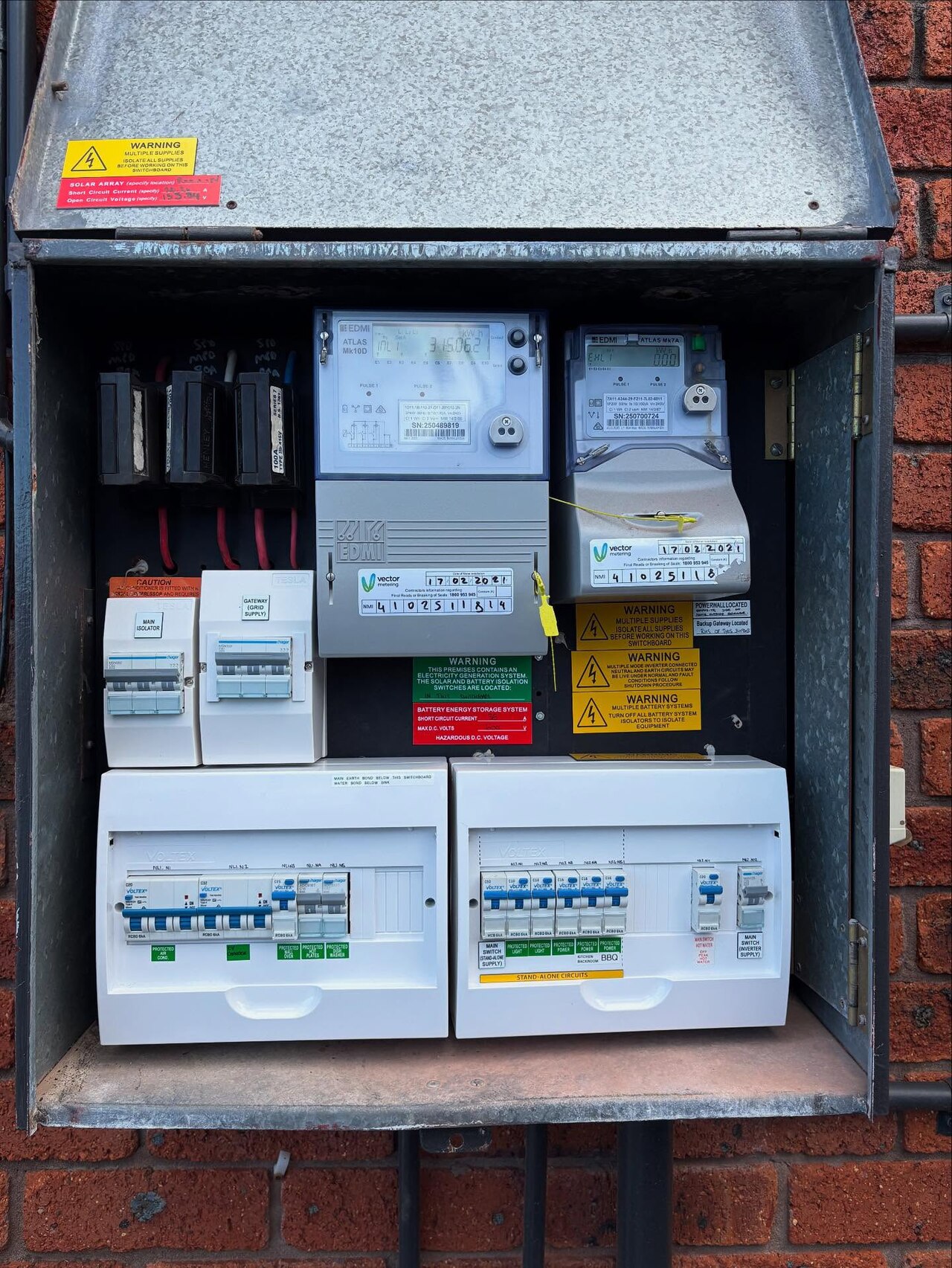
Option 1: install solar panels and a battery together
- The system can be designed as one unit, with compatible equipment chosen from the start.
- You go through one planning, approval and installation process.
- Some installers may pass on labour or visit efficiencies, but this varies by quote.
- Upfront spending is higher.
- If your usage has not been assessed properly, you can end up with more storage than you need.
Option 2: install solar first and add a battery later
- The first outlay is usually lower than buying both at once.
- You get time to see your real consumption and surplus generation.
- You can choose a battery later based on measured needs.
- A retrofit may add labour, equipment or upgrade costs.
- Inverter compatibility or replacement can become an issue.
- Incentives and product availability may change in the meantime.
| Factor | Solar and battery together | Solar first, battery later |
|---|---|---|
| Upfront spend | Higher | Lower at the start |
| System design | Planned as one coordinated system | Depends on how well it was future-proofed |
| Installation visits | One planning and install process | Two separate jobs |
| Equipment compatibility | Chosen together | Must suit the existing inverter and setup |
| Battery sizing | Based on estimates before the system runs | Can use real usage and surplus data |
| Retrofit costs | Largely avoided | Possible extra labour or equipment |
| Incentive timing | Locked in at installation | Rules and values may change by the time you buy |
Is a combined package cheaper?
It can be, but it is not guaranteed. A combined job may involve fewer visits and a single design, yet the final price still depends on equipment, labour, inverter choice, electrical upgrades, backup equipment, monitoring and how each installer builds its margin.
For a like-for-like view, ask each installer to price three things: the solar system alone, the battery alone and the combined package. If the combined figure is lower than the sum of the parts, get that discount confirmed in writing.
Why this guide does not show an example price comparison
Package prices, labour costs and rebate values move quickly, and a hypothetical figure could be mistaken for a quote. Instead, use the checklist in the quotes section below to compare real offers on equal terms. For current price ranges, see our guide to solar battery cost in Australia.
Is the package worth it over time?
Value depends on more than the package price. A battery adds value by storing electricity you would otherwise export cheaply and using it when you would otherwise buy from the grid. How much it earns comes down to how much useful energy it stores and displaces.
| Factor | Why it matters |
|---|---|
| Evening and overnight usage | This is the demand a battery can serve |
| Surplus solar generation | Little surplus means little to store |
| Import rates and export credits | The gap between them sets the value of stored energy |
| Usable capacity and efficiency | Not all stored energy comes back out |
| Degradation and warranty | Capacity declines over the battery’s life |
| Incentives and financing | They change the price you actually pay |
| Time in the property | Savings accrue over years, so your plans matter |
Nobody can honestly guarantee a payback period. If an installer quotes one, ask for the formula, the assumptions and the source of each input, and check that the same electricity benefit is not counted twice. Battery warranty terms and expected degradation should be part of that conversation.
Who should consider buying both together?
- Homeowners already planning a new solar installation.
- Households with meaningful evening electricity demand.
- Homes likely to have regular surplus solar to shift into the evening.
- People who want blackout backup designed in from day one.
- Buyers who value one coordinated design and installation.
- Anyone who has checked compatibility, current incentives and the total installed cost.
That does not mean every home needs a battery immediately.
Who may be better off installing solar first?
- Households with a limited upfront budget.
- Homes where future energy use is uncertain.
- Low current electricity use or limited surplus solar.
- People who expect big changes, such as an EV or electrified appliances, and want data first.
- Owners who want to see real solar production before choosing storage.
If you stage the purchase, plan for the battery from the start. Not every solar-only system can be upgraded easily, because the existing inverter, system configuration and future battery products all shape the options.
Can you add a battery to solar panels later?
Often yes, but it needs checking. The main considerations are:
- The type and model of your existing solar inverter.
- Whether the battery will be AC-coupled or DC-coupled.
- Whether a hybrid inverter is needed.
- Compatibility between the battery and your equipment.
- Switchboard capacity and any electrical upgrades.
- Space and installation conditions.
- Network or export requirements.
- Whether you want blackout backup.
An AC-coupled battery adds its own inverter alongside your existing solar inverter, which is why it is commonly used for retrofits. A DC-coupled battery connects through a hybrid inverter, which often means replacing the existing inverter on a retrofit. A site assessment and a review of your current equipment are the only reliable way to know which route suits you.
Does buying both together make blackout backup easier?
It gives you the chance to design backup in from the beginning, but only if the package explicitly includes it. An ordinary grid-connected solar and battery system may not power your home in a blackout unless the right equipment and configuration are installed.
If backup matters, ask about:
- Backup gateway or isolation equipment.
- Essential-load circuits versus whole-home backup.
- Battery power output and the starting loads of your appliances.
- Battery reserve settings and expected runtime.
- Whether solar can recharge the battery during an outage.
Do not assume every package supports backup. Confirm it in writing.
How do rebates and incentives affect the decision?
Federal support for batteries comes through the Cheaper Home Batteries Program, which started on 1 July 2025 and is delivered through Small-scale Technology Certificates. According to the Department of Climate Change, Energy, the Environment and Water, eligible batteries must be approved by the Clean Energy Council and installed by an accredited installer, with nominal capacity between 5 and 100 kWh. The same program guidance says the battery can be installed with new or existing solar that meets safety and other requirements.
Solar Choice reports that from 1 May 2026 the support tapers by size, with full support for the first 14 kWh of usable capacity, a reduced share for the next band and a much smaller share between 28 and 50 kWh. Nothing applies above 50 kWh. A bigger battery is therefore not rewarded in proportion. The certificate factor also steps down on a schedule, with the next reduction reported for 1 January 2027, so confirm current figures with the Clean Energy Regulator before you decide.
Rooftop solar panels have their own certificate entitlement under the same scheme, calculated separately from the battery. Our solar and battery rebate page explains how we help households check eligibility.
State and territory differences
- NSW: The NSW Government says its battery installation discount is no longer available and cannot be claimed alongside the federal discount. It has a separate incentive for connecting a battery to a virtual power plant, which can be combined with the federal discount. Read how a virtual power plant in NSW works before you commit.
- South Australia: The state Home Battery Scheme is closed to new applications, according to the SA Department for Energy and Mining. Ask your electricity retailer which Retailer Energy Productivity Scheme activities are available to you.
A government rebate is different from a loan, a retailer offer, a VPP payment or an installer discount. Never assume you qualify or that programs can be combined. Check your 2026 battery rebate eligibility with the installer and the official sources before you accept a price.
How do electricity tariffs affect the package decision?
Tariffs decide what stored solar is worth. The main drivers are:
- Your electricity import rates.
- Your solar export credits.
- Time-of-use pricing, where evening power costs more.
- Demand charges, where they apply.
- Controlled or grid charging, where your equipment and plan support it.
- Retailer battery offers and VPP arrangements.
Two households with identical solar systems can get very different value from a battery because their tariffs and usage patterns differ. No single tariff is best for everyone, so compare your own bill against your own plan.
What size battery should you buy with solar panels?
Size the battery around how you use energy, not around the largest model available. Consider your daily consumption, evening and overnight loads, expected solar surplus, usable capacity, desired backup loads, seasonal changes, future EV charging and budget.
Know the difference between energy and power. Capacity in kWh is how much energy the battery stores, while output in kW is how much it can deliver at once. A battery with plenty of kWh but low kW may not run several large appliances together. For a deeper walk-through, see how to choose the right solar battery.
How to compare solar and battery package quotes
Compare quotes on equivalent equipment, installation scope and backup capability. Ask every installer for:
- Solar panel make, model and total system capacity.
- Battery make, model, nominal capacity and usable capacity.
- Inverter make, model and configuration.
- Continuous power output and surge capability.
- Whether backup is included and exactly which circuits it supports.
- The complete installed price, including GST where applicable.
- All electrical upgrades and exclusions.
- Incentive assumptions and eligibility conditions.
- Warranty terms for each major component.
- Monitoring and commissioning arrangements.
- Export and network connection considerations.
- After-sales service and support.
- Compatibility with future expansion.
- Written confirmation of any claimed package discount.
Common mistakes when buying solar and a battery together
- Choosing a package only because it advertises a discount.
- Buying a battery without understanding your usage.
- Overestimating bill savings.
- Assuming every package includes blackout backup.
- Ignoring usable capacity and power output.
- Skipping inverter compatibility checks.
- Treating incentives as guaranteed.
- Comparing quotes with different inclusions.
- Overlooking warranty limitations.
- Forgetting future needs such as an EV or system expansion.
Frequently asked questions
Is it cheaper to buy solar panels and a battery together?
Sometimes, but not always. A combined job can reduce duplicated planning and installation effort, yet equipment, inverter choice, upgrades and installer margins still drive the price. Ask for the solar, the battery and the combined package priced separately, and get any claimed package discount confirmed in writing before you compare offers.
Should I install solar panels before buying a battery?
It can make sense if your budget is limited, your usage is uncertain or you want to see real solar production first. Plan for the battery from the start, because the inverter and system design affect how easily storage can be added, and incentives may change in the meantime.
Can I add a battery to my existing solar panels?
Often, yes. An AC-coupled battery can usually work with an existing solar inverter, while a DC-coupled option typically needs a hybrid inverter. Compatibility, switchboard capacity and your backup goals all matter, so an installer should assess your existing equipment on site before quoting.
Do solar and battery packages include blackout backup?
Not automatically. Many grid-connected systems will not power your home in an outage unless backup equipment and circuits are specified. Ask whether backup is included, which circuits it covers, the battery’s power output and whether solar can recharge the battery during a blackout.
Will a battery eliminate my electricity bill?
No. A battery lets you use more of your own solar after sunset, but you may still import from the grid on cloudy days, during high demand or when the battery is empty. You will also usually still pay supply charges, so any savings depend on your usage and tariff.
Are combined solar and battery packages eligible for rebates?
Eligibility depends on the battery, the installer, the installation date and the program rules at the time. The federal Cheaper Home Batteries Program applies to eligible batteries, and state programs differ. Check your 2026 battery rebate eligibility with official sources and your installer, and never assume incentives can be combined.
Is a larger battery always better value?
No. A larger battery costs more and only pays back if you can fill and use it. Federal support also tapers for larger sizes under the program rules reported from 1 May 2026. Size the battery to your evening usage, surplus solar, backup goals and budget instead of buying the biggest option.
How do I compare solar and battery quotes?
Compare like with like. Check panel, inverter and battery models, usable capacity, power output, backup scope, electrical upgrades, warranties, monitoring, support and the full installed price including GST. Ask each installer to state its incentive assumptions in writing so you can see what you would actually pay.
What should I check before accepting a package deal?
Confirm exactly what is included and excluded, whether backup is part of the price and how the battery connects to your solar. Check warranty terms, the incentive conditions you need to meet, network approval and after-sales support. Get any package discount stated in writing against equivalent equipment.
Your next step
The right choice comes down to your usage, your tariff, your budget and whether you want backup. Compare the complete installed price, system compatibility, backup scope and your current incentive eligibility rather than the headline discount.
If you would like a recommendation built around your property and electricity usage, you can book a free assessment with UR Local Solar. For the broader range of residential options, see our residential solar and battery services.