

A home battery system stores electrical energy so you can use it later. When it is connected to rooftop solar, it can hold surplus daytime generation for the evening instead of exporting all of it to the grid. If you are comparing solar panels and battery storage proposals, it helps to understand every part of the system, because a battery is only one piece of the equipment you are paying for.
This guide explains how a complete home battery system works, which components it includes, how the main configurations differ and what to check before you accept a quote. It is written for households that already have solar, are planning a new solar-and-battery installation, or simply want to understand the equipment before talking to an installer.
Key takeaways
- A home battery system is a set of components: the battery, an inverter, a battery management system, monitoring, protection equipment and, if you want blackout backup, extra backup hardware.
- Batteries store DC electricity. Where that DC is converted to AC is what separates AC-coupled from DC-coupled systems.
- No single configuration is best for every home. The right design depends on your existing solar, your goals and the equipment chosen.
- A battery alone does not guarantee power in a blackout. Backup needs compatible hardware and dedicated circuits.
- Compare quotes like for like: usable capacity, continuous power, inverter arrangement, backup scope and exclusions.
How does a home battery system work?
In a typical home with rooftop solar and a battery, electricity follows a simple order of priority, although the exact behaviour depends on the equipment, your electricity tariff and the energy-management settings your installer configures.
- Your solar panels generate electricity during daylight.
- Household appliances use that solar electricity first.
- Surplus generation may charge the battery.
- Later, the battery can supply household loads when solar output is low.
- If the battery is empty or at its reserve level, the home can still import electricity from the grid.
- Excess electricity may be exported to the grid where your system and electricity plan allow it.
Illustrative example only. This is not a universal operating sequence. A household might run the dishwasher and fridge from solar around noon while the battery charges from the surplus. In the evening, as solar fades, the lights, television and cooking draw from the battery. Late at night, if the battery reaches its configured reserve, the home draws from the grid.
| Time of day | Typical energy source for the home | What the battery may be doing |
|---|---|---|
| Morning | Solar, topped up by the battery or grid | Discharging or idle, depending on settings |
| Midday | Solar | Charging from surplus solar |
| Evening | Battery, with grid import if needed | Discharging to household loads |
| Overnight | Remaining battery energy, then the grid | Discharging until it reaches its reserve level |
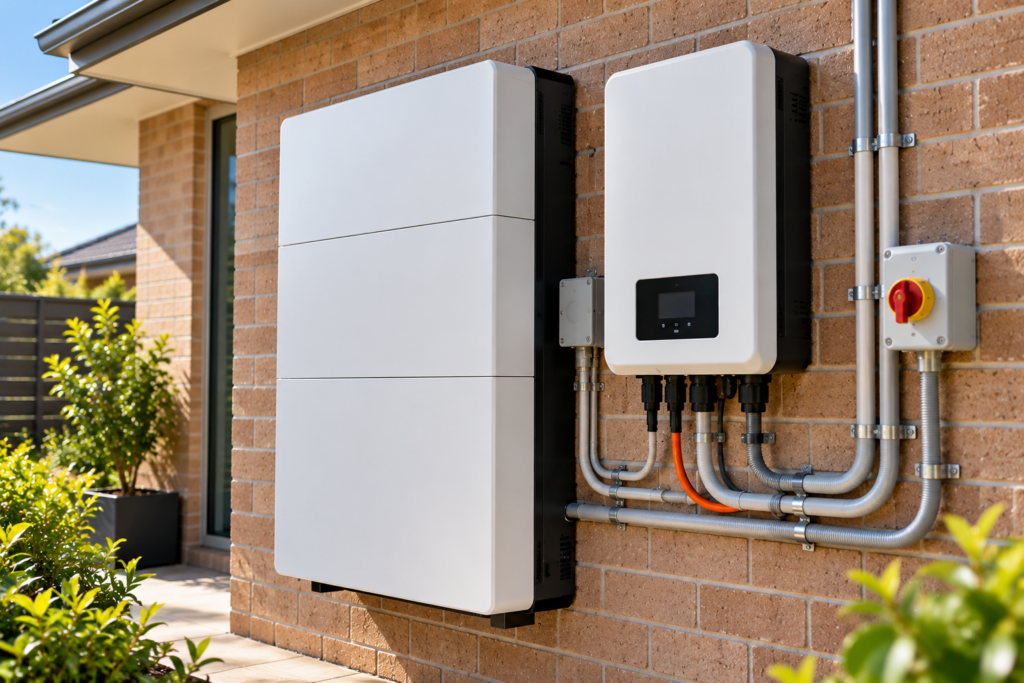
Main components of a home battery system
The parts below work together as one system. Not every installation includes every item in the same form, so the table that follows is a guide to what to ask about rather than a fixed specification.
Solar panels
Solar panels generate the electricity that most home batteries are designed to store. A battery can sometimes be added to an existing solar installation, depending on the inverter and layout you already have. See our guide on adding a battery to an existing solar system for the retrofit side of the question.
Solar or battery inverter
An inverter converts electricity between direct current (DC) and alternating current (AC). Solar panels and batteries work in DC, while your home and the grid use AC. Depending on the design, a system may use your existing solar inverter plus a separate battery inverter, or a single hybrid inverter that manages both.
Battery storage unit
The battery stores the energy. Two figures matter. Nominal capacity is the headline size of the battery, and usable capacity is the portion you can actually draw on. Both are measured in kilowatt-hours (kWh), which describe how much energy is stored. Power output, measured in kilowatts (kW), describes how fast that energy can be delivered.
Battery management system
A battery management system (BMS) monitors and manages the battery’s operation, such as cell condition, temperature and charge limits. Its exact functions vary by product design, so check the manufacturer’s documentation.
Energy monitoring and management
Monitoring software usually shows solar generation, household consumption, battery state of charge and grid imports and exports. Management settings let your installer or you set preferences such as backup reserve, within what the product allows.
Switchboard and electrical protection
Suitable switchboard capacity, isolation and protection devices are part of a compliant installation. This is licensed electrical work, not a DIY task.
Backup equipment
To supply selected circuits or a whole home during a blackout, additional equipment such as a backup-capable inverter or gateway, plus dedicated wiring, may be required.
Metering and grid connection
Grid-connected systems interact with your meter, your imports and exports, and requirements set by your electricity network. Network rules can influence which configuration and export settings are available at your property.
| Component | What it does | Why it matters | What to check |
|---|---|---|---|
| Solar panels | Generate DC electricity | Source of the energy that can charge the battery | Existing system size, age and inverter type |
| Inverter | Converts between DC and AC | Sets the configuration and often the power limits | Model, hybrid or separate, continuous and surge power |
| Battery unit | Stores energy | Determines how much energy is available later | Usable capacity, power rating, warranty terms |
| Battery management system | Monitors and protects the battery | Supports safe and consistent operation | Built-in or external, per the product documentation |
| Monitoring and controls | Shows energy flows and applies settings | Lets you see and tune how the system behaves | App access, data visibility, reserve and mode settings |
| Switchboard and protection | Isolates and protects the electrical installation | Essential for a safe, compliant installation | Whether upgrades are needed and included in the quote |
| Backup equipment | Supplies chosen circuits during an outage | A battery alone may not power the home in a blackout | Which circuits are backed up and what the hardware includes |
| Metering and grid connection | Records imports and exports | Affects export limits and tariff outcomes | Network approval, meter changes, export settings |
Main types of home battery system
Australian homes use a handful of common configurations. None is universally best, because the right choice depends on your existing equipment, your goals and your property.
| System configuration | How it connects | Common use case | Key considerations |
|---|---|---|---|
| AC-coupled battery | Battery connects on the AC side, alongside the existing solar inverter | Adding a battery to an existing solar system | Compatibility with the current inverter, extra conversion stages, network limits |
| DC-coupled battery | Battery connects on the DC side, before the inverter | New solar-and-battery installations | Needs a compatible hybrid inverter and access to the DC side |
| Hybrid inverter system | One inverter manages solar, battery and grid | New installs or replacing an old inverter | Battery compatibility, inverter replacement cost, backup options |
| Battery retrofit | Battery added to existing panels, often with a separate battery inverter | Households that already have solar | Existing inverter brand and age, switchboard capacity |
| New solar-and-battery installation | Designed together as one system | Homes without solar, or major upgrades | Equipment matching, total system design, quote inclusions |
Real-world performance depends on the specific equipment and design, not merely the coupling label. Claims that one configuration always delivers better efficiency or lower cost should be checked against product documentation.
AC-coupled vs DC-coupled systems explained
The difference comes down to where the battery connects, and therefore how many times electricity is converted between DC and AC.
DC-coupled. Solar DC electricity can flow to the battery before it is converted to AC. A hybrid inverter usually manages this. Industry guides describe this as fewer conversion stages when charging from solar, but the real-world gain depends on the equipment.
AC-coupled. Solar panels feed the existing solar inverter, which produces AC. A separate battery inverter, or a battery with a built-in inverter, then converts that AC to DC for storage and back to AC when the battery discharges. This is why AC coupling is a common route for adding a battery to existing solar.
Several practical factors can shape the choice:
- Existing solar. If your current inverter has no accessible DC connection for a battery, AC coupling is often the practical route. Some solar systems built around microinverters, for example, are typically paired with AC-coupled batteries.
- Hybrid inverters. Replacing an ageing solar inverter with a hybrid inverter can open the way to DC coupling, but that is a larger job than adding a battery alone.
- Network limits. Some electricity networks count the combined inverter capacity toward connection limits, which can affect AC-coupled designs.
- Backup. Both AC-coupled and DC-coupled systems can support backup when the right hardware is installed. The coupling type alone does not decide it.
How does a home battery connect to rooftop solar?
There are four common arrangements, and the suitable one depends on existing equipment, product compatibility, your electrical supply, network requirements and what you want from the system.
- Battery alongside a new solar system. The solar panels, inverter and battery are chosen together, which gives the designer the most freedom.
- Battery added to existing solar. Usually an AC-coupled design, or an inverter replacement if DC coupling is wanted.
- Hybrid inverter system. One inverter handles panels, battery and grid connection.
- Separate battery inverter. A dedicated inverter handles the battery while your solar inverter keeps handling the panels.
Wiring and connection are licensed electrical work done to manufacturer instructions and Australian requirements. This guide deliberately does not give installation steps.
What happens when the battery is full or empty?
When the battery is full. If solar generation exceeds household demand and the battery cannot take more charge, the extra electricity may be exported to the grid, or limited (curtailed) if export is capped by your system settings or network rules.
When the battery is empty or at reserve. Many systems let you set a minimum state of charge. Once the battery reaches that reserve, grid electricity supplies the home when solar is not enough.
Reserve and backup. A higher reserve setting can keep more energy available for a blackout, but it also means less energy is used for everyday savings. Operating modes and energy-management settings differ between products, so the priority order is not identical for every system.
Can a home battery system work during a blackout?
Not automatically. Ordinary grid-connected solar systems are designed to shut down when the grid fails. This protection is called anti-islanding, and it stops your system feeding electricity into lines where workers may be repairing the network. A standard grid-connected inverter can still shut down during an outage even when a battery is installed.
To keep power flowing, the system needs backup-capable hardware that safely isolates your home from the grid and runs selected circuits from the battery, and sometimes from your solar panels in daylight, depending on the design. The main points to understand are:
- Essential circuits or whole home. Backing up only essentials such as the fridge, lights and internet makes a battery last longer than trying to run the entire house.
- Continuous and surge power. Your appliances must fit within the system’s power limits, including the short surge when motors start.
- Capacity and runtime. How long backup lasts depends on usable capacity, your loads and the reserve setting. Runtime cannot be promised without verified product and load details.
- Solar recharge. Whether panels can recharge the battery during an outage depends on the system design.
RACV advises that solar batteries are not an uninterruptible power supply and are not suitable for people who depend on essential medical equipment. If backup matters for health or safety reasons, discuss it directly with your installer.
Battery capacity vs power output
Capacity is how much energy a battery stores, measured in kilowatt-hours (kWh). Power output is how fast it can deliver that energy, measured in kilowatts (kW). Think of a water tank: capacity is the size of the tank, and power is how wide the tap is.
A simple household example shows why this matters. A 2 kW heater running for five hours uses 10 kWh. A battery with plenty of stored energy but a low power rating may still be unable to run that heater, an oven and an air conditioner at the same time. When comparing systems, look at usable capacity, continuous output and surge capability together, and match them to the circuits you want to run.
How efficient is a home battery system?
Round-trip efficiency describes how much of the energy used to charge a battery can be retrieved later, under the manufacturer’s stated measurement method. It is not a single universal number, because it varies with:
- battery chemistry and product design
- inverter configuration and the number of conversion stages
- operating conditions and temperature
- charging and discharging power
- the energy the system uses to run itself
- how the manufacturer tested it
Be careful when comparing efficiency figures on different data sheets. Numbers measured under different conditions are not directly equivalent. Ask whether a figure is a manufacturer specification or from independent testing, and what test conditions apply.
Can a home battery work without solar panels?
Some systems can charge from the electricity grid, depending on the product, configuration, electricity retailer arrangements and applicable rules. A grid-charged battery stores energy bought at one time of day for use at another, while a solar-charged battery stores energy your panels produced.
The financial value depends on tariffs, charging windows, conversion losses, operating restrictions and your household’s usage, so it is not automatic or identical for every home.
How long does a home battery system last?
Several different ideas get mixed together, so it helps to separate them:
- Warranty period. What the manufacturer or installer commits to in writing, with conditions.
- Expected service life. How long the system may keep operating in practice.
- Cycle life. The number of charge and discharge cycles a battery is rated for.
- Capacity retention. How much usable capacity remains as the battery ages.
- Real-world performance. What you actually experience in your home and climate.
Temperature, usage patterns, charging behaviour, chemistry and product design all influence degradation, and no fixed lifespan can be promised. For more detail, see our guide on how long a solar battery lasts.
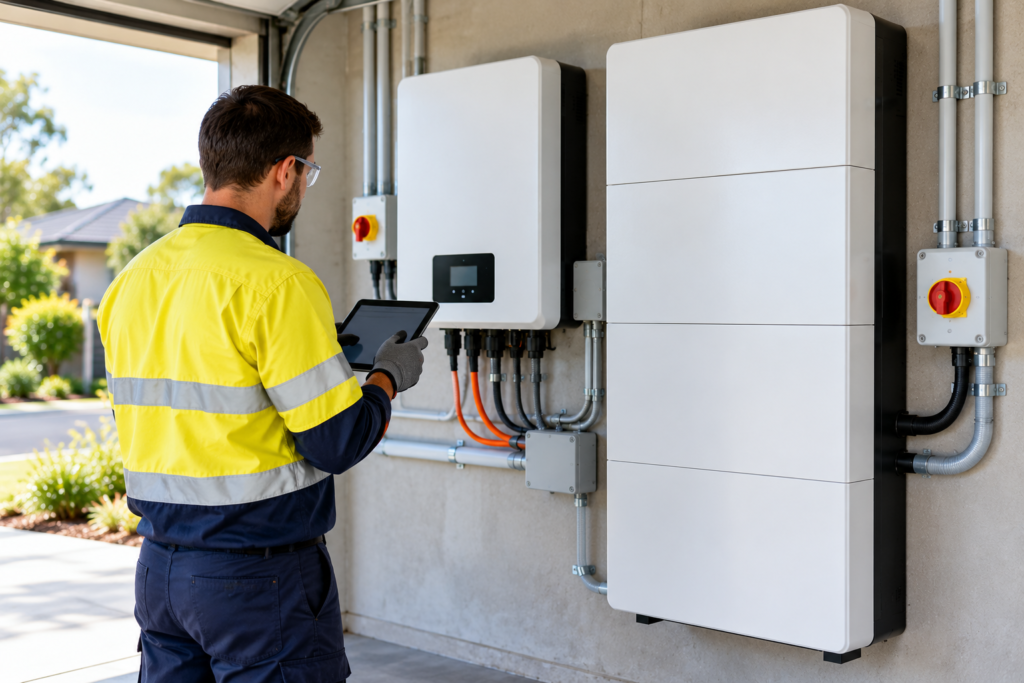
Safety and installation considerations
Home batteries are safe when they are installed and commissioned correctly. In Australia, battery installations are guided by AS/NZS 5139:2019, the standard covering installation and safety requirements for battery energy storage systems, alongside the wiring rules and the manufacturer’s instructions. Points worth discussing with your installer include:
- product-specific installation requirements
- an appropriate installation location and environmental conditions such as temperature and weather exposure
- electrical protection and isolation
- safe access and working space
- proper commissioning and handover
- qualified and authorised installation professionals
Location rules can be detailed, so rely on your installer rather than assuming a spot is suitable. Our guide to solar battery safety in SA and NSW covers what homeowners should know.
What does a complete home battery system cost?
The installed price depends on more than the battery itself. Factors that move a quote include:
- battery model and usable capacity
- inverter requirements
- existing solar equipment
- electrical or switchboard upgrades
- backup equipment
- installation complexity
- monitoring and energy-management components
- commissioning and any inclusions or exclusions
Because these items differ between homes, always compare a complete installed price rather than an equipment-only figure. For pricing context, see our solar battery cost guide.
Rebates, incentives and electricity plans
The federal Cheaper Home Batteries Program, run through the Small-scale Renewable Energy Scheme, can reduce the upfront cost of an eligible battery. The Department of Climate Change, Energy, the Environment and Water explains that the program changed from 1 May 2026 and that the level of support now varies with battery size, so the benefit is not the same for every system. Check the official program page for the current rules, and check your 2026 battery rebate eligibility before you rely on any figure.
It also helps to keep other offers separate. Government incentives, state grants or loans, retailer offers, virtual power plant payments and bill credits are different things, and the advertised incentive is not necessarily the amount your household receives. Our solar battery rebate guide walks through the schemes.
How to compare home battery system quotes
Compare like for like. A larger battery or a lower headline price does not tell you whether two proposals deliver the same result. Use this checklist:
- Battery model and usable capacity
- Inverter model and configuration
- Continuous and surge power
- Backup equipment and which circuits are covered
- Compatibility with your existing solar
- Installation and switchboard work
- Monitoring and communications
- Warranty conditions
- Current incentive assumptions
- Total installed price and exclusions
- After-sales support
Common misconceptions about home battery systems
- “Every battery gives blackout protection.” No. Backup needs compatible hardware and dedicated circuits.
- “A bigger battery is always better.” Not necessarily. The right size depends on your usage and goals.
- “Capacity and power mean the same thing.” They do not. kWh is stored energy, kW is delivery rate.
- “All batteries work with all solar inverters.” Compatibility depends on the products and configuration.
- “A battery eliminates electricity bills.” It can reduce grid imports, but fixed charges and usage patterns still apply.
- “Every battery can recharge from the grid.” This depends on product capability and your plan.
- “All systems are equally efficient.” Efficiency varies by design and test method.
- “Every household gets the same rebate.” Eligibility and the outcome depend on programme rules and the system installed.
Frequently asked questions
What is a home battery system?
A home battery system is a set of equipment that stores electrical energy for later use. It normally includes a battery, an inverter, a battery management system, monitoring and electrical protection. Paired with rooftop solar, it can store surplus daytime generation and supply the home when solar output is low.
How does a home battery system work?
Solar electricity first powers your appliances, then any surplus can charge the battery. When solar output drops, the battery can supply the home. If the battery is empty or at its reserve level, the home draws from the grid. Exact behaviour depends on the equipment, tariff and settings.
What components are included in a home battery system?
Typical components are the battery unit, a hybrid or battery inverter, a battery management system, monitoring and control software, switchboard and protection equipment, and metering and grid connection. Blackout backup requires extra hardware and dedicated circuits. The exact list varies between products and installations.
What is the difference between AC-coupled and DC-coupled batteries?
An AC-coupled battery connects on the AC side and uses its own inverter, so solar electricity is converted more than once on its way to storage. A DC-coupled battery connects on the DC side, usually through a hybrid inverter. Performance depends on the equipment, not the label alone.
Can I add a battery to my existing solar panels?
Often yes, but it depends on your current inverter, the available connection options, your switchboard and your network’s requirements. AC coupling is a common retrofit route. An installer should assess your equipment before recommending a design. See our guide on adding a battery to existing solar for more detail.
Does a home battery work during a blackout?
Only if the system includes backup-capable hardware and wiring. Standard grid-connected solar shuts down during an outage for safety, even with a battery installed. Backup can cover essential circuits or the whole home, and runtime depends on capacity, loads and reserve settings.
What is the difference between battery capacity and power?
Capacity, in kilowatt-hours (kWh), is how much energy the battery stores. Power, in kilowatts (kW), is how quickly it can deliver that energy. A battery with high capacity but low power output may not run several large appliances at once, so both figures matter.
Can a battery charge from the electricity grid?
Some can, depending on the product, configuration, retailer arrangements and applicable rules. Grid charging is not automatically available or financially beneficial for every household. The value depends on tariffs, charging windows, conversion losses and how you use electricity.
How efficient are home battery systems?
Efficiency varies by chemistry, product design, inverter configuration, temperature and charge rate. Round-trip efficiency compares energy retrieved with energy used to charge, under a stated test method. Figures from different manufacturers may not be directly comparable, so ask what conditions the number was measured under.
How long does a home battery last?
No fixed lifespan can be promised. Warranty period, expected service life, cycle life and capacity retention are different measures. Temperature, usage patterns and product design all affect how a battery ages, so review the warranty terms and conditions carefully before you buy.
Do I need a hybrid inverter?
Not always. A hybrid inverter is common in DC-coupled and new installations. Many retrofits use an AC-coupled battery that keeps your existing solar inverter. Whether you need one depends on your current equipment, your goals and the design your installer proposes.
How do I choose the right home battery system?
Start with what you want it to do, such as lowering evening grid use or providing backup. Then compare usable capacity, continuous power, inverter arrangement, compatibility with your solar, warranty terms and the total installed price, including exclusions.
Plan your home battery system
If you would like to talk through your existing solar equipment, household usage, backup needs and which configuration may suit your property, you can request a free, no-obligation assessment with the UR Local Solar team in Adelaide or Sydney. Bring a recent electricity bill and any details of your current solar system, and we can go through your options without pressure.