


Solar battery cost in Australia in 2026 ranges from about $6,000 installed for a small 5 kWh battery to $26,500 or more for 20 kWh, before any federal discount. For a common 10 kWh battery, indicative installed quotes sit around $10,000 to $15,000 before the discount, and CHOICE reports about $7,000 to $11,000 after it.
Your own price depends on usable capacity, the brand, whether you need a new inverter, backup power and how complex the installation is. This guide from our team for solar panel and battery installation in South Australia and NSW explains what those numbers include, what they leave out and how to compare quotes fairly.
One rule runs through the whole article. Equipment prices, installed prices and prices after the federal discount are different numbers, so we keep them separate.
How Much Does a Solar Battery Cost in Australia in 2026?
The most useful way to read the solar battery cost question is by usable battery size. The table below uses WhySolar’s price tracker, which collects indicative installer quotes from across Australia. Prices include installation and GST, and they are shown before the federal Cheaper Home Batteries discount.
Installed solar battery prices before the federal discount (2026)
| Usable capacity | Indicative installed price | What is included | Important qualifications |
|---|---|---|---|
| 5 kWh | $6,000 to $8,500 | Battery supplied and installed, GST included | Standard single-storey home with a simple switchboard |
| 10 kWh | $10,000 to $15,000 | Battery supplied and installed, GST included | A new hybrid inverter may be extra if your current inverter is not compatible |
| 13.5 kWh | $13,500 to $18,500 | Battery supplied and installed, GST included | Switchboard upgrades, two-storey work and long cable runs cost extra |
| 15 kWh | $15,000 to $20,000 | Battery supplied and installed, GST included | Regional travel can add to the quote |
| 20 kWh | $19,500 to $26,500 | Battery supplied and installed, GST included | Prices vary widely by brand and system design |
Source: WhySolar battery price tracker, installer quotes checked September 2026.
Prices after the federal discount look quite different. CHOICE published the following approximate installed costs in June 2026, using data from its partner SolarQuotes. These figures include basic installation and already deduct the federal battery discount.
Installed solar battery prices after the federal discount (2026)
| Battery size | Approximate installed cost after the discount | Notes |
|---|---|---|
| 10 kWh | $7,000 to $11,000 | Basic installation; complex jobs can cost considerably more |
| 15 kWh | $11,000 to $15,000 | Basic installation |
| 20 kWh | $14,000 to $19,000 | Basic installation |
| 30 kWh | $18,000 to $22,000 | Discount tapers above 14 kWh |
| 50 kWh | $24,000 to $30,000 | Discount tapers further above 28 kWh |
Source: CHOICE, “Solar home battery rebate” (June 2026), citing SolarQuotes data.
Do not compare a figure from the first table with a figure from the second. One is a gross price and the other is a net price. Neither is a national average, because no public source publishes an audited average installed price.
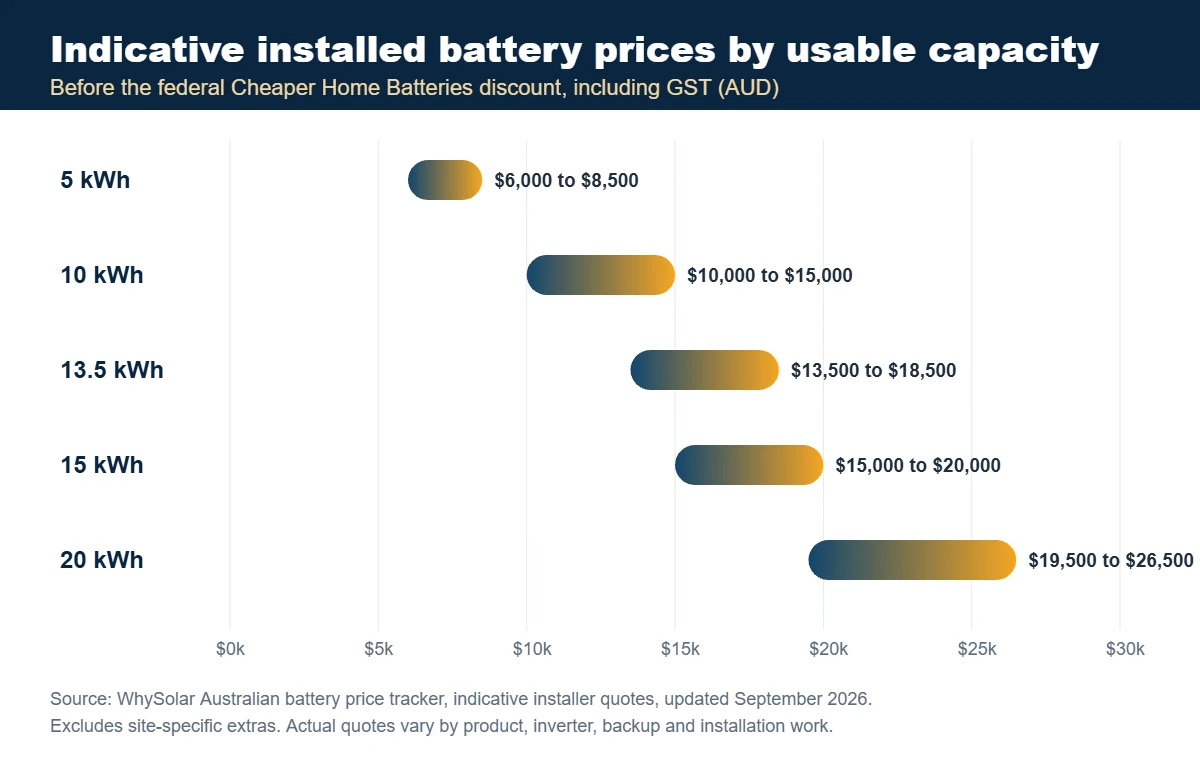
Solar Battery Cost by Capacity
Solar battery cost rises with size. Bigger batteries cost more in total, but the price per kilowatt-hour often falls as size increases. In WhySolar’s 2026 tracker, installed prices for individual models range from about $664 to $1,488 per usable kWh before the federal discount. That gap shows why two batteries of similar size can be thousands of dollars apart.
Nominal capacity versus usable capacity
Nominal capacity is the total energy a battery can hold. Usable capacity is the share you can actually draw on, after the manufacturer reserves some charge to protect the cells. Always compare quotes on usable kWh, because the federal discount is also calculated on usable capacity.
kWh and kW are not the same thing
Kilowatt-hours (kWh) describe how much energy a battery stores. Kilowatts (kW) describe how much power it can deliver at once. Continuous power is what the battery can supply steadily, while peak power covers short bursts, such as an air conditioner starting. A large battery with low power output may still struggle to run several appliances together.
Capacity alone does not tell you which battery suits your home. Evening electricity use, spare solar generation, backup needs, inverter compatibility and expansion options all matter just as much.
What Is Included in the Installed Price?
An installed quote should list every part of the job, not just the battery, because the true solar battery cost includes labour and supporting equipment. Depending on your system, a complete solar battery quote may include:
- The battery hardware, with the model and usable capacity stated
- A compatible hybrid or battery inverter, or integration with your existing inverter
- Battery management and monitoring equipment, including any gateway device
- Cabling, isolators and electrical protection devices
- Mounting hardware, plus any required fire-rated backing or protective barriers
- Labour, configuration and commissioning
- Monitoring app setup
- Backup hardware or a backup circuit, if you asked for it
- Switchboard modifications, where required
- GST
Not every home needs every item, so the solar battery cost on two quotes can differ for good reasons. However, if a line is missing, ask whether it is excluded or simply not required for your property.
What Additional Costs Should You Check?
Extra charges are the main reason a final solar battery cost lands above the advertised price. These are potential costs rather than universal charges, and they depend on your home.
- Inverter compatibility or replacement. Solar Calculator lists hybrid inverter prices from about $2,310 to $4,650, depending on brand and size (May 2026).
- Backup power. Solar Calculator estimates backup capability adds roughly $1,500 to $3,500 (May 2026).
- Switchboard or electrical upgrades. Older switchboards may need work before a battery can be connected safely.
- Complex installation conditions. Two-storey homes, difficult access and long cable runs usually take more time.
- Site protection. Bollards, sun shields or fire-resistant backing may be needed, depending on the battery location.
- Network requirements. Your network may set export or connection conditions that affect system design.
Ask each installer to price these items in writing. That way, you can see which quote is genuinely complete.
How Much Does It Cost to Add a Battery to Existing Solar Panels?
Adding a battery to existing solar panels is called a retrofit. Here, the solar battery cost depends mostly on whether your current inverter can work with a battery.
- AC-coupled batteries include their own inverter and connect on the AC side of your home. They can often sit alongside your existing solar inverter.
- DC-coupled batteries connect to a hybrid inverter shared with your solar panels. If your current inverter is not a compatible hybrid model, it may need replacing.
Solar Calculator’s May 2026 figures show how this can play out. Its 10 kWh battery is listed at $8,880 when bought with new panels and $10,680 when added to existing solar, with both figures after the federal discount. The difference largely reflects the hybrid inverter that many retrofits need.
That pattern is not universal. Some AC-coupled batteries cost the same in either situation. Read our guide on adding a battery to an existing solar system to check compatibility before you request quotes.
How Does the Cheaper Home Batteries Program Affect Solar Battery Cost?
The federal Cheaper Home Batteries Program lowers the upfront solar battery cost for eligible installations. It works through Small-scale Technology Certificates (STCs), which your installer usually claims and passes on as a discount. As a result, the discount is normally shown as a line on your quote rather than a payment you receive later.
From 1 May 2026, the discount tapers by battery size. The Clean Energy Regulator confirms the full rate applies to the first 14 kWh, 60% applies from 14 to 28 kWh, and 15% applies from 28 to 50 kWh. It also confirms that the installation date, not the contract date, sets your discount.
Example federal discount values in 2026
| Usable capacity | Approximate discount | Assumptions |
|---|---|---|
| 10 kWh | $2,584 | 68 STCs at $38 each |
| 13.5 kWh | $3,458 | Full rate applies |
| 20 kWh | $4,522 | Reduced rate above 14 kWh |
Source: WhySolar, September 2026. STC prices move with the market, so the actual dollar value on your quote may differ.
The rate is set to fall again on 1 January 2027 and then every six months until 2030, according to WhySolar and Solar Choice. Eligibility also depends on the program rules on your installation date. For the full rules, see our Cheaper Home Batteries Program 2026 guide.
The tapering has already changed buying behaviour. Clean Energy Regulator data shows the average battery size fell from about 36 kWh in April 2026 to about 23 kWh in May and June.
State support varies. South Australia’s earlier home battery scheme has closed, while NSW runs separate battery and virtual power plant incentives with their own conditions. Check the current NSW rules before assuming a state discount applies.
Why Does Solar Battery Cost Vary So Much?
Several factors push a solar battery cost up or down:
- Usable capacity. More storage costs more in total.
- Brand and features. Software, app quality and integration differ between products.
- Battery chemistry. Most home batteries sold in Australia use lithium iron phosphate (LFP), but designs and cell suppliers still differ.
- Inverter set-up. A built-in inverter, a new hybrid inverter or a separate battery inverter each change the price.
- Backup requirements. Whole-home or partial backup needs extra hardware.
- Installation complexity. Access, wall type, cable runs and switchboard condition all affect labour.
- Warranty and service. Warranty length, throughput limits and local support vary.
The most expensive battery is not automatically the best one. Equally, the cheapest quote can become costly if it leaves out work your home needs.
How to Compare Solar Battery Quotes
The fairest way to compare solar battery cost is to compare quotes with the same scope of work. Otherwise, you are comparing different jobs, not different prices.
Solar battery quote checklist
- Total installed price, with GST shown
- Battery model and usable capacity in kWh
- Continuous and peak power output in kW
- Inverter configuration: existing, new hybrid or built in
- Backup capability and which circuits it covers
- Inclusions and exclusions, in writing
- Federal discount amount and the installation date it assumes
- Any switchboard, cabling or site work
- Battery, inverter and workmanship warranty terms
- Monitoring set-up and commissioning
- Payment terms and deposit amount
- Installer accreditation, which you can verify independently
If two quotes differ by thousands of dollars, ask both installers to explain the gap line by line.
What Is the Right Battery Size for Your Budget?
Start with your evening and overnight electricity use, then check how much spare solar you export during the day. A battery much larger than your overnight use may sit partly empty. A battery that is too small will leave you buying grid power at night.
Backup also matters. If you want essential circuits to run during an outage, you may need more power output, not only more capacity. Our guide on how to choose the right solar battery walks through sizing step by step.
Finally, weigh solar battery cost against value over time. If you want to know whether the savings justify the spend, read whether a solar battery is worth it in Australia, which covers savings and payback.
Key Takeaways
- Solar battery cost in Australia in 2026 starts around $6,000 installed for 5 kWh and exceeds $26,500 for some 20 kWh systems, before the federal discount.
- A 10 kWh battery is about $10,000 to $15,000 before the discount and about $7,000 to $11,000 after it, based on different 2026 sources.
- Compare batteries on usable kWh, power output in kW and the full scope of work.
- Inverter replacement, backup hardware and switchboard work are the most common extra costs.
- The federal discount tapers above 14 kWh and depends on your installation date.
Frequently Asked Questions
How much does a solar battery cost in Australia in 2026?
Installed prices start at about $6,000 for a 5 kWh battery and reach $19,500 to $26,500 for 20 kWh, before the federal discount, according to WhySolar installer quotes from September 2026. Your price depends on usable capacity, brand, inverter needs, backup and installation complexity, so a written quote for your home is the only reliable figure.
How much does a 10 kWh home battery cost installed?
WhySolar lists about $10,000 to $15,000 installed for a 10 kWh battery before the federal discount. CHOICE, using SolarQuotes data, reports about $7,000 to $11,000 after the discount with basic installation. A new hybrid inverter, backup hardware or switchboard work can push the final price higher.
Does a solar battery price include installation?
Not always. Some advertised prices cover the battery hardware only, while others are installed prices. Check whether the quote includes labour, cabling, protection devices, commissioning, monitoring, any inverter work and GST. If it does not state these items clearly, ask the installer to confirm them in writing.
Is it cheaper to add a battery to existing solar panels?
Not necessarily. A retrofit avoids the cost of new panels, but your existing inverter may not support a battery. Solar Calculator lists a 10 kWh battery at $8,880 with new panels and $10,680 when added to existing solar, both after the federal discount, mainly because of the hybrid inverter.
Does the government battery discount reduce the installation cost?
Yes, for eligible installations. The Cheaper Home Batteries Program is usually applied as a discount on your quote. From 1 May 2026 it is calculated on usable capacity and tapers above 14 kWh. The value depends on the STC market price and the rules in force on your installation date.
Why do solar battery quotes differ so much?
Quotes differ because of the battery model, usable capacity, inverter set-up, backup hardware, site conditions and warranty terms. One quote may include a switchboard upgrade or backup circuit that another leaves out. Compare quotes with the same scope of work before deciding which offers better value.
Get a Clear Solar Battery Quote
If you are comparing battery options for a home in South Australia or NSW, our solar battery systems team can talk through capacity, inverter compatibility, backup and any discount that may apply to your installation. Book a solar battery consultation to discuss your home and request a written quote.