

Commercial solar battery systems store electricity on your site so you can use it after sunset, during a costly peak or when the grid drops out. If your business is weighing solar and battery storage for business, the real question is whether a battery earns its place on your bill, your operations or both.
This guide gives you a way to test that before you request quotes. It covers how a battery works on a commercial site, which tariffs and load patterns suit one, how federal and NSW support applies to businesses in 2026, and when you should skip it.
The short answer
A commercial solar battery system is a battery, inverter and control equipment that stores electricity on a business site for later use. It tends to pay off when your site has strong after-sun demand, a tariff with a demand charge or equipment that cannot afford an outage. It rarely pays off when you already use most of your solar during the day.
Key takeaways
- Start with 12 months of interval meter data, not a battery brand.
- A battery only helps with demand charges if your tariff has one and the battery discharges at your peak.
- Backup power works only if the system is installed with backup enabled.
- Federal support covers batteries of 5 to 100 kWh nominal capacity and tapers above 14 kWh, so the biggest battery is not automatically the best value.
- NSW businesses can also check a state discount that opened on 1 September 2026.
What a commercial solar battery system does
A battery does three jobs on a commercial site, and most projects are built around one of them.
- Shift solar into the evening. Excess daytime generation charges the battery instead of being exported, then supplies your after-sun load.
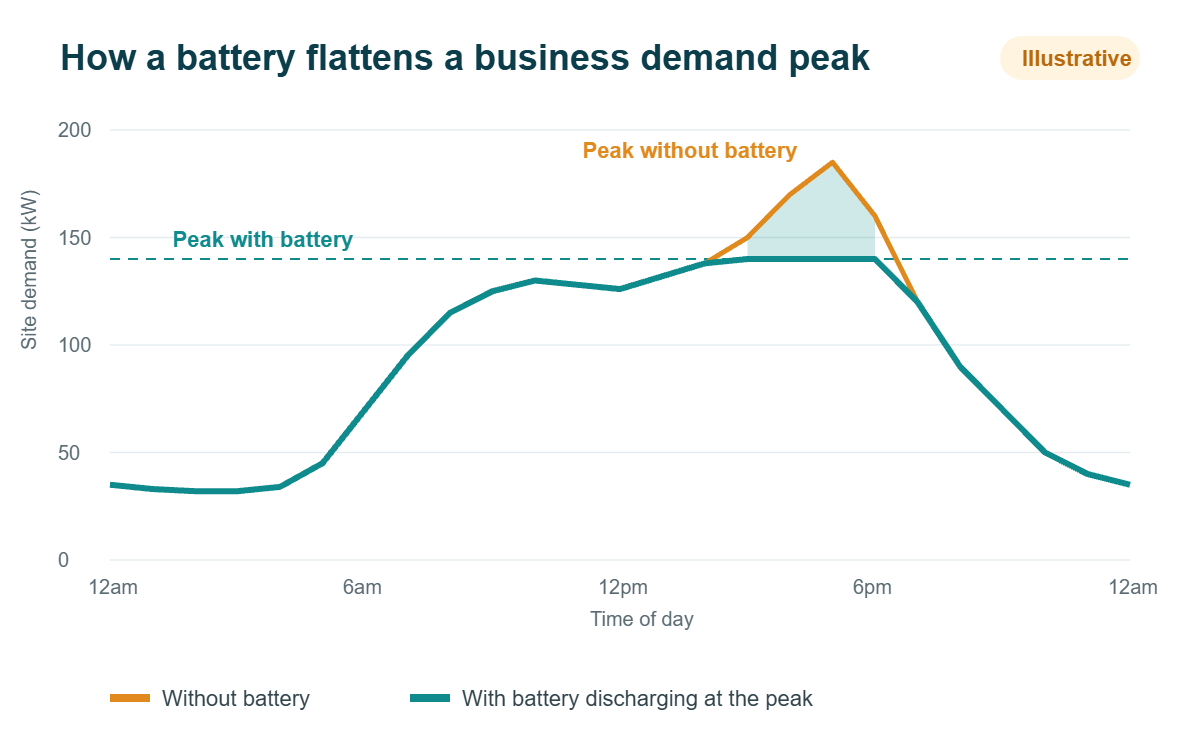
- Flatten demand peaks. The battery discharges when your site would otherwise hit its highest demand for the billing period.
- Keep critical loads running. With backup enabled, the battery can supply selected circuits during an outage. The NSW Government notes this depends on backup being enabled.
If you are still working out the solar side, our commercial solar installation page explains how a business system is assessed and designed.
How commercial solar battery systems reduce demand charges
A demand charge is a tariff component based on the highest demand your site places on the network in a billing period, then reset for the next period. Many business tariffs include a demand component, and your bill or retailer will tell you if yours does.
A battery reduces that charge by supplying part of the load while your site approaches its peak. The catch is timing. One missed half hour can still set the charge for the month, so the battery’s power rating (kW), its control software and its settings matter as much as its storage (kWh).
If your tariff has no demand component, a battery’s value comes from shifting solar and from backup instead.
Does your site suit a battery?
Use this table as a screening tool. Bring your answers to any assessment.
| Signal on your site | Why it matters | What to bring |
|---|---|---|
| Meaningful load after sunset or overnight | Gives stored solar something to displace | 12 months of interval data |
| A demand charge on your bill | Peak reduction can be worth more than energy shifting | Recent bills and tariff name |
| Solar already exporting at a low value | A battery keeps more of that energy on site | Solar size and export limit |
| Equipment that cannot lose power | Backup protects operations | List of critical circuits |
| Planned growth such as EV chargers or cooling | Future load changes the right size | Expansion plans |
| Switchboard, space and three phase supply | Installation cost and feasibility | Photos and single line diagram if available |
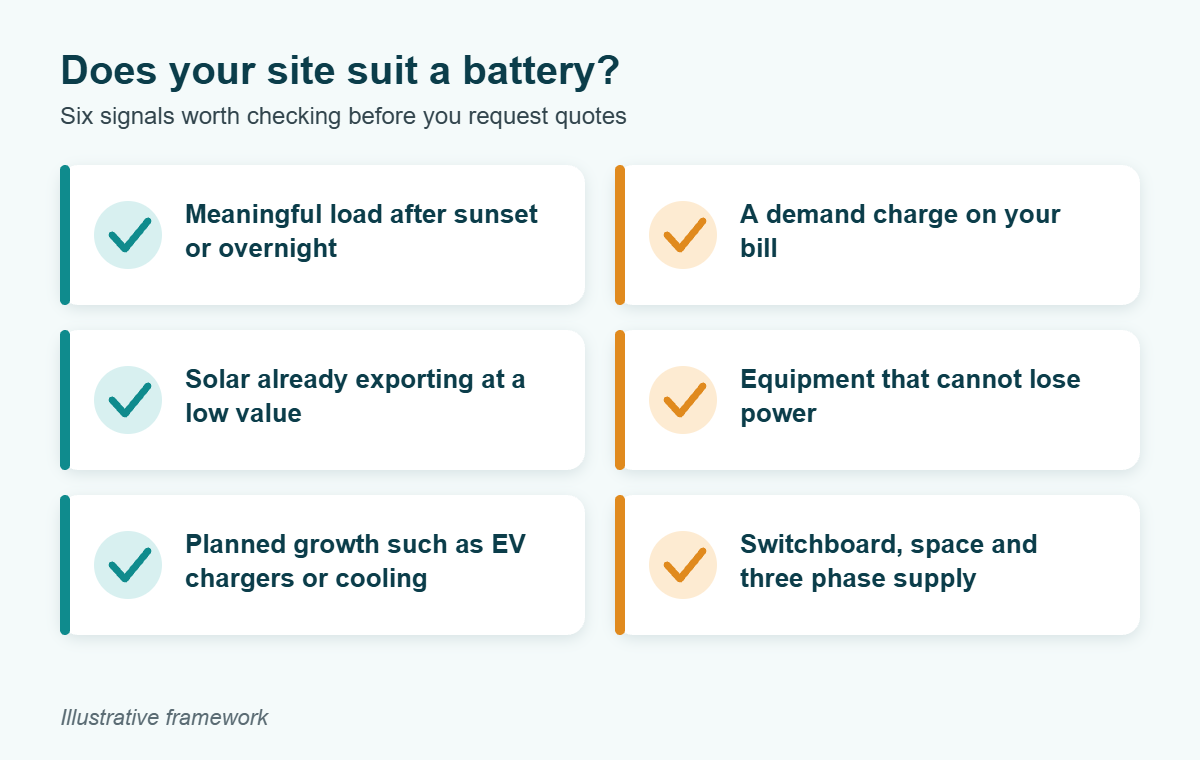
Treat three or more strong signals as a reason to request a detailed assessment. One or two signals usually means you should model the numbers carefully first.
How to size a commercial battery
Size from your data, not from your roof.
- Pull 12 months of interval data from your retailer or network.
- Mark your peak windows and your after-sun load.
- Decide the main job: savings, backup or both.
- Size power and energy separately. Power (kW) handles the peak. Energy (kWh) sets how long it lasts.
- Compare at least two sizes with the incentive effect shown as its own line.
Size matters more than usual because of how federal support works. The Clean Energy Regulator says you cannot claim certificates for an additional battery at the same premises if you upgrade later. Choose the size you will live with.
Federal support for business batteries
The Australian Government’s Cheaper Home Batteries Program supports households and businesses installing eligible small-scale batteries. The Clean Energy Regulator lists the main requirements as of October 2026:
- a new battery of 5 to 100 kWh nominal capacity, installed in a single job
- installed with a new or existing solar system of no more than 1 MW
- on the Clean Energy Council approved battery list
- capable of joining a virtual power plant if grid connected
- installed by a Solar Accreditation Australia accredited installer
- one eligible battery per premises
Certificates are only issued for the first 50 kWh of usable capacity, and since 1 May 2026 the support tapers by size:
| Usable capacity | Share of the STC factor applied |
|---|---|
| First 14 kWh | 100% |
| Over 14 to 28 kWh | 60% |
| Over 28 to 50 kWh | 15% |
The regulator also publishes a schedule that steps the factor down over time, from 6.8 for May to December 2026 to 5.7 for January to June 2027. That means value per kilowatt hour falls as time passes, and it falls fastest for larger batteries.
Do not treat this as a flat discount. Instead, check your 2026 battery rebate eligibility with an installer who can confirm your site. Our solar battery rebate guide for 2026 covers the household side in more detail.
NSW businesses: the new state discount
If your premises are in Sydney or elsewhere in NSW, there is a second source of support. The NSW Government says its Batteries for businesses incentive is available from 1 September 2026, with no current closing date, for batteries from 20 kWh to 30 MWh. It excludes residential buildings and data centres, and off-grid sites cannot access it.
The NSW page describes the discount as usually applied to your quote and gives indicative ranges. These are 30 to 40 per cent when a battery is installed with new solar, and 20 to 30 per cent for a battery only. If you already have solar, you need to add new solar capacity of at least 25 per cent of the battery’s capacity within 90 days. Actual amounts vary by installer, location and equipment, and batteries commissioned before 1 September 2026 do not qualify.
NSW states the discount can be combined with the federal program if you meet both sets of rules. Your installer has to offer it, so ask for it to appear as a separate line on every quote. For how rebates fit together on our side, see our rebate information.
Adelaide and South Australia
Federal support applies in South Australia in the same way. State support for business batteries changes, and we have not confirmed a current South Australian grant for this article. Ask each installer which programs are open for your site, and have them put any discount in writing before you sign.
Adding a battery to existing commercial solar
Many businesses already have solar and want to add storage. The Clean Energy Regulator allows a battery to be installed with an existing system if that system meets state electrical safety rules. The inverter the battery connects to must be virtual power plant capable.
In practice, that means an assessment should check your inverter, switchboard, export limits and network approval before anyone promises a result. You can see how we have approached business sites on our commercial solar projects page.
When a battery is not the right move
A battery is the wrong move more often than sellers admit. Pause if any of these apply:
- Your load is almost entirely daytime and your solar already covers it.
- Your tariff has no demand component and no meaningful peak or off-peak spread.
- You have no solar yet and your budget only allows one upgrade. Solar first is usually the cleaner step.
- Your capacity needs exceed 100 kWh nominal, which is outside the federal small-scale rules and needs a separate business case.
- Your switchboard or site needs major electrical work that outweighs the benefit.
A good installer will tell you this, and will show the numbers either way.
Ownership, safety and maintenance
A commercial battery is equipment you will live with for years. The Clean Energy Regulator recommends a safety check every year by a licensed electrician accredited by Solar Accreditation Australia. Ask about monitoring, firmware updates and warranty terms before you buy, and read our solar battery maintenance tips so you know what routine care looks like.
Questions to ask before you sign
- Which of the three jobs is this battery designed for?
- What are the kW and kWh ratings, and why those sizes?
- Is backup included, and which circuits does it cover?
- Which incentives apply to my site, and are they shown as separate lines?
- Does the quote cover switchboard work, network approval and commissioning?
- What does the warranty cover, and who services it?
- What do my accountant and tax adviser say about treatment for my business?
Commercial solar battery FAQs
How much does a commercial solar battery system cost?
The cost depends on battery capacity, inverter power, backup scope, switchboard upgrades and installation complexity, so a reliable figure needs a site assessment and a written quote. Ask for the incentive discount to appear as its own line item, and be cautious of any price given without your electricity usage data.
Can a business claim the federal battery rebate?
Some can. The Cheaper Home Batteries Program supports eligible households and businesses installing a new, Clean Energy Council approved battery of 5 to 100 kWh nominal capacity with solar, using a Solar Accreditation Australia accredited installer. Only one battery per premises can claim, so check your 2026 battery rebate eligibility before you sign.
Does a commercial battery reduce demand charges?
It can, if your tariff includes a demand charge and the battery discharges when your site peaks. Demand charges are set by your highest demand in a billing period, so a single missed peak can still set the charge. Your interval meter data shows whether a battery would have made a difference.
What size commercial battery do I need?
Size depends on your evening or peak load, your solar generation and whether the goal is savings or backup, not on roof area. Start with 12 months of interval data. Federal support tapers above 14 kWh and only one battery per premises can claim, so compare several sizes before you choose.
Can I add a battery to existing commercial solar?
Often, yes. The Clean Energy Regulator says an eligible battery can be installed with an existing solar system that meets state electrical safety rules, and the inverter the battery connects to must be virtual power plant capable. An assessment confirms whether your inverter, switchboard and network approval suit a battery.
Is a business eligible for the NSW battery discount?
NSW businesses may be eligible for a discount on batteries from 20 kWh to 30 MWh from 1 September 2026 under the Peak Demand Reduction Scheme. Residential buildings and data centres are excluded, off-grid sites do not qualify, and the discount is larger when new solar is installed with the battery. Your installer must offer it.
Your next step
UR Local Solar designs and installs commercial solar and battery systems for businesses across Adelaide, South Australia and Sydney, NSW. Send us your recent bills and, if you have them, your interval data, and we will request a commercial assessment that tells you whether a battery suits your site, and which size and incentives to compare.
Sources
- Clean Energy Regulator, Solar batteries, last updated 29 October 2026.
- NSW Climate and Energy Action, Batteries for businesses incentive, updated 29 September 2026.