

You have two quotes for a 10kW solar system with battery. Both say 10kW. One is thousands of dollars higher than the other, and neither explains why.
The headline size only describes the solar array. The battery, inverter, backup needs and site work shape much of the total. This guide explains what to compare, so you can read any offer for solar and battery solutions for Australian homes with confidence.
The Short Answer
The price of a 10kW solar system with battery depends on more than the 10kW. The battery capacity in kWh, the inverter and how the two connect, any blackout backup, the roof and switchboard, the warranties and the rebates you qualify for each move the total. Two quotes only compare fairly when all of these match.
What Does a 10kW Solar System With Battery Actually Include?
A complete system is more than panels and a battery. It usually includes solar panels, a solar or hybrid inverter, a battery with its management system, mounting, cabling and protection, metering and monitoring, backup switching where required, and installation, commissioning and compliance work. Configurations vary, so two quotes may include different parts. Some quotes also use 10kW for the inverter, so confirm both figures.
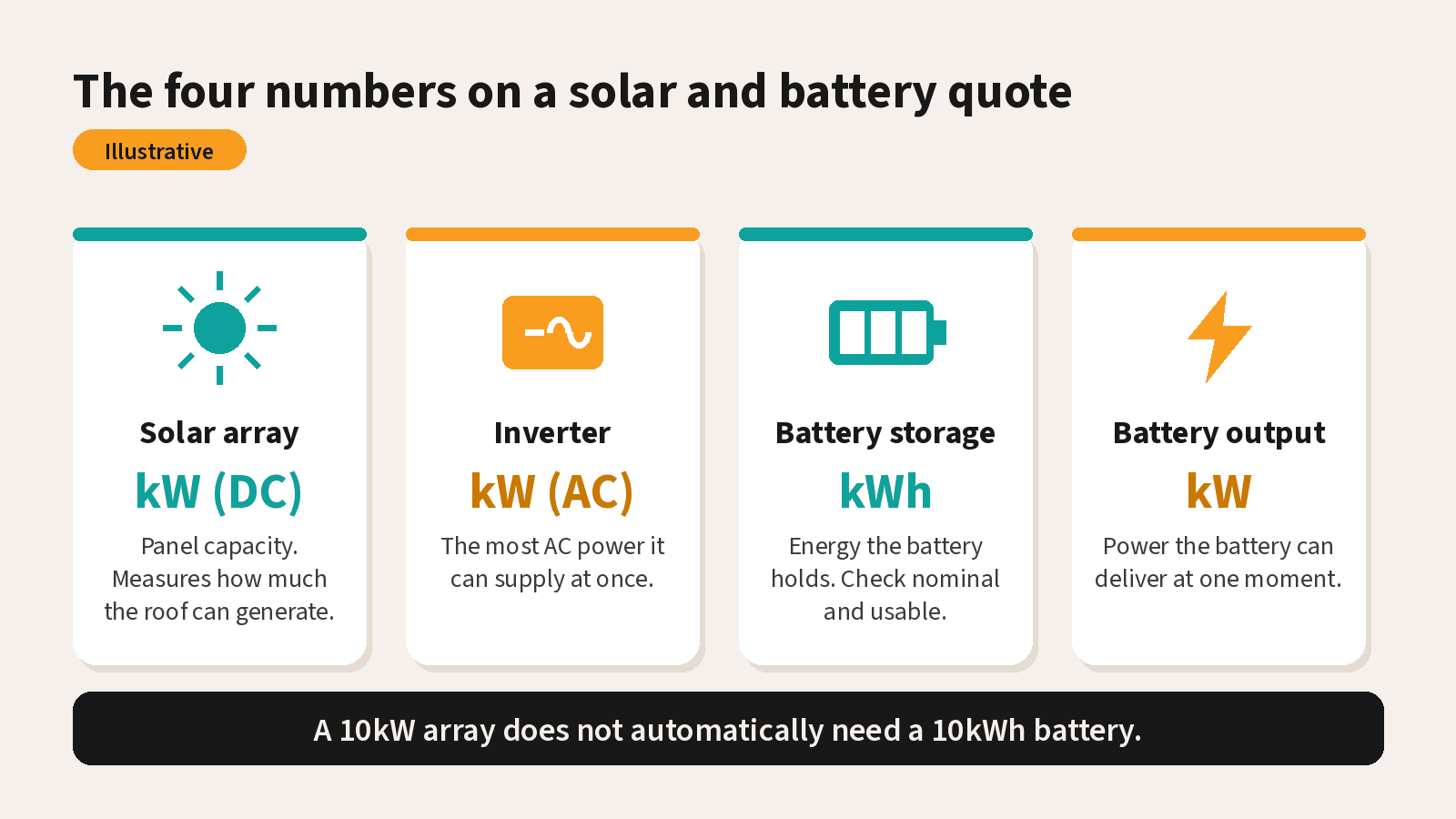
Four numbers get mixed up. Array size is solar panel capacity in kW. Inverter size is its AC output in kW. Battery capacity is stored energy in kWh. Battery output is the power it can deliver at once, in kW. A 10kW system does not automatically need a 10kWh battery, because array kW measures generation and battery kWh measures storage.
The 8 Main Factors That Drive the Price
1. Solar panel brand, type and total capacity
Panel brand, technology and efficiency change the equipment cost, and the array layout must suit the roof. A higher-efficiency panel is not automatically best for every roof, so ask why a model was chosen. Panel count and roof layout also set how many mounting parts and how much cabling the job needs.
2. Battery capacity and battery technology
Cost rises with capacity, but nominal and usable capacity differ, so compare usable kWh. A bigger battery is not better if the household cannot use the extra stored energy. The benchmarks below price 10 kWh and 20 kWh batteries very differently, and the right size follows evening use, not the array. Our guide to how home battery systems work covers the basics.
3. Inverter type and system configuration
A standard inverter handles solar only. A hybrid inverter manages solar and battery together (DC-coupled). An AC-coupled battery adds its own inverter, which often suits an existing system. Your current inverter can change the cost of adding a battery to existing solar.
4. Backup power requirements
A battery does not automatically provide blackout protection. Options are no backup, essential circuits or whole home, and the more you want to keep running, the more equipment and electrical work is usually needed. Ask which circuits stay on and for how long. Solar Choice outlines the caveats in its home battery guide.
5. Roof type, design and installation complexity
Roof material, pitch, orientation, access, available space, cable routes and switchboard condition all affect labour. Identical equipment can still produce different installation quotes. Battery position matters too: garage, wall or outside.
6. Electrical upgrades and compliance work
Some homes need switchboard upgrades, protection equipment or metering changes. Network rules apply too. SA Power Networks, for example, publishes flexible export options that can affect system settings. Ask which rules apply at your address.
7. Product warranty, support and equipment quality
Compare warranty length, conditions and who services claims. A longer warranty does not always mean a better product, so read the terms and check support, monitoring and service arrangements. Ask who services a claim and whether labour for removal and reinstallation is covered.
8. Rebates, incentives and location-specific requirements
The federal Cheaper Home Batteries Program issues STCs for eligible new batteries. The Clean Energy Regulator lists the factor per kWh as 6.8 for May to December 2026, falling to 5.7 from January 2027. Rebates are not automatic. Conditions include an approved battery, an accredited installer and VPP capability (the ability to join a virtual power plant), and the rebate tapers: the first 14kWh counts in full, 14 to 28kWh at 60 per cent and 28 to 50kWh at 15 per cent. Because the factor falls on 1 January 2027, ask which period your installation date falls into. Check your 2026 battery rebate eligibility before signing.
Example Cost Breakdown: Where Does the Money Go?
This table shows what each part covers. It has no dollar amounts, because they depend on your home and equipment.
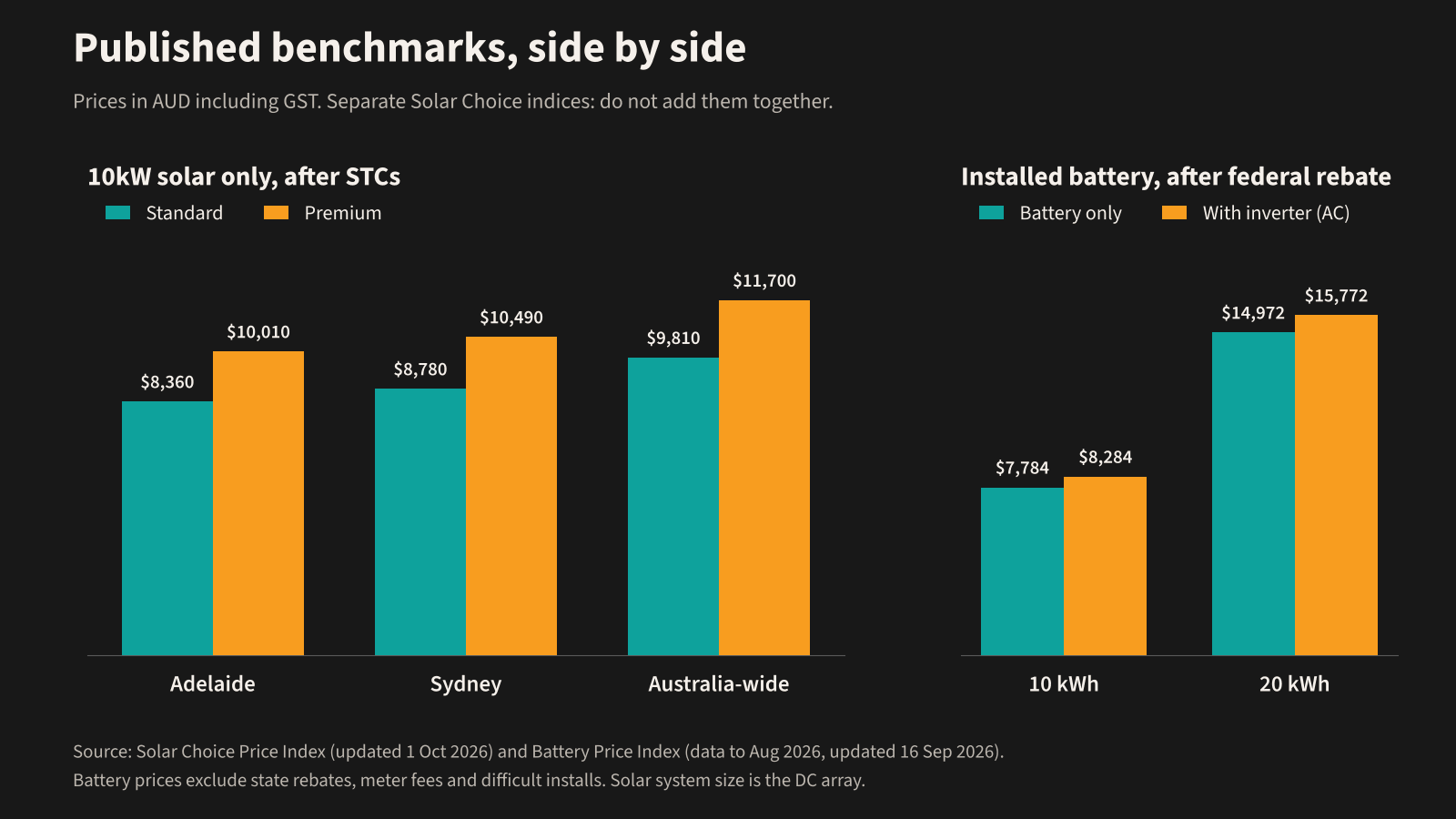
For a public benchmark, the Solar Choice Price Index (updated 1 October 2026) lists 10kW systems by DC array size, after STCs and including GST.
In these figures, premium hardware sits about 20 per cent above standard, and Sydney about 5 per cent above Adelaide. Hardware tier and location both move the price.
Solar Choice’s Battery Price Index (data to August 2026) lists installed batteries including installation, GST and the federal rebate. It excludes state rebates, meter fees and difficult installs.
These are separate benchmarks from different dates, so do not add them together. They are no substitute for an itemised, property-specific quote. For wider context, see our guide to solar battery costs in Australia.
Why Two 10kW Solar and Battery Quotes Can Be So Different
The example below is a hypothetical scenario to illustrate the process. It is not a real client. It compares two imaginary quotes for the same 10kW array.
Both quotes could be fair. Quote B may cost more, but it is not universally better. It buys different outcomes, so only like-for-like items can be compared. Capacity, backup and site work usually explain most of the gap.
How to Check Whether a Solar and Battery Quote Is Fair
Ask for an itemised quote, then confirm each point:
- The actual solar panel capacity in kW.
- The inverter capacity and model.
- The battery nominal and usable capacity in kWh.
- The battery continuous power output in kW.
- The backup capability and exactly which circuits are covered.
- The product warranties and their conditions.
- Whether electrical upgrades are included.
- The installation, commissioning and compliance inclusions.
- The applicable rebates and eligibility rules.
- That every quote uses equivalent equipment and installation scope.
Is a 10kW Solar System With Battery Right for Every Home?
It suits homes with strong electricity use, enough roof space and a clear plan for the stored energy. Larger households with high evening use, or plans for an electric vehicle, may benefit more. Daytime and evening use, tariffs, feed-in tariffs, backup needs and future electric vehicle plans all matter. Our guide on whether solar panels and a battery together are worth it explores the trade-offs.
When This May Not Be the Right Move
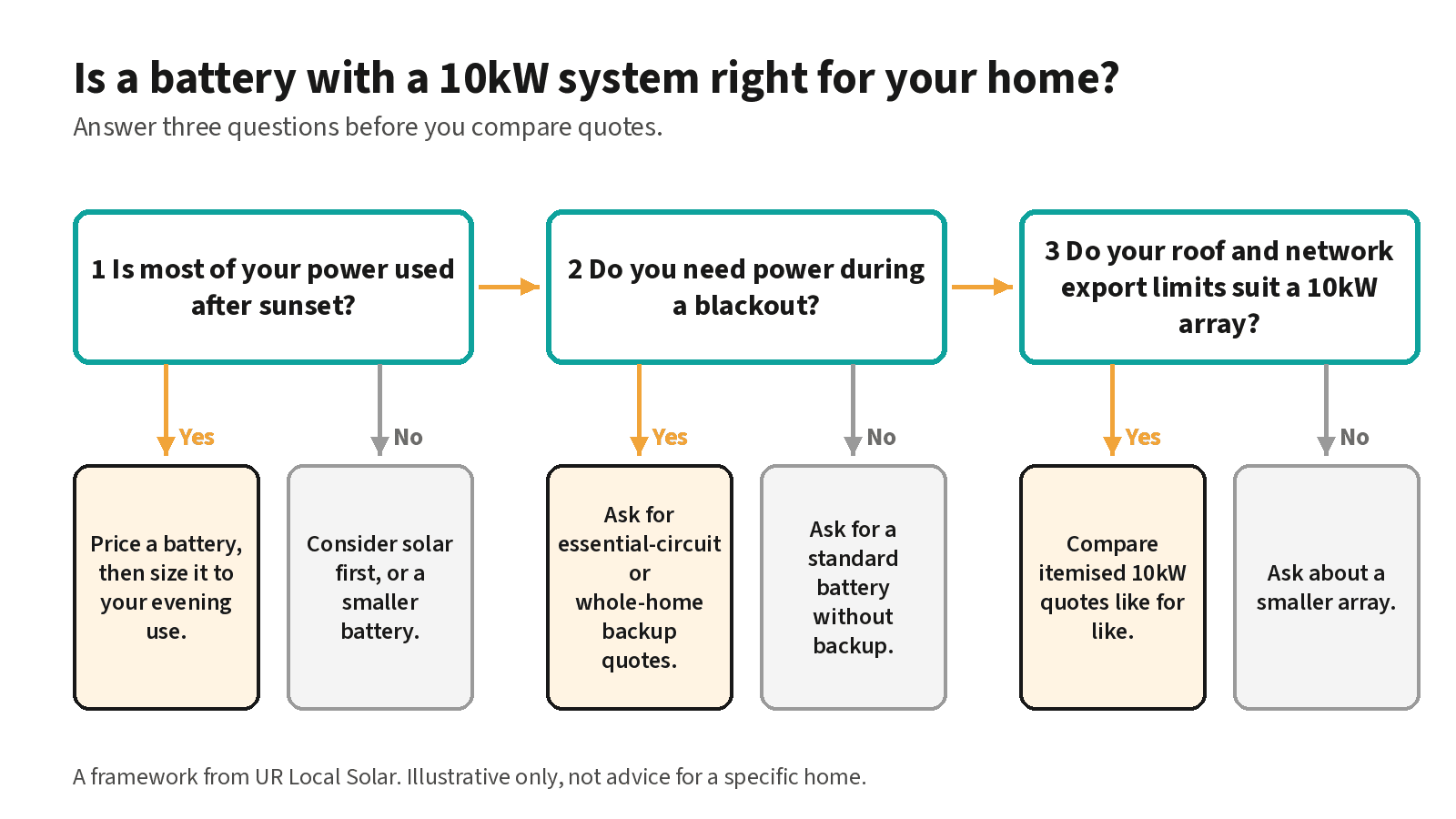
- Most of your power is used in the daytime. A smaller battery, or solar first, may suit better.
- Your roof is small or shaded. A smaller array may fit better.
- Your goal is whole-home blackout cover. A battery sized for everyday use may not deliver it.
- Your network limits exports. A larger array may add less than expected.
A 10kW system should follow your usage, not the other way around.
Questions to Ask Before Accepting a Solar and Battery Quote
- What are the exact array, inverter and battery capacities, nominal and usable?
- Is every component compatible, and who confirms it?
- What is the total installed price, and what is excluded?
- What do the warranties cover, and who handles claims?
- What will keep running in a blackout?
- What support and monitoring follow installation?
Frequently Asked Questions
How much does a 10kW solar system with a battery cost in Australia?
It varies with battery size, inverter, backup needs, roof and rebates. Published benchmarks above price solar and batteries separately, but only an itemised, property-specific quote shows your total.
What size battery is suitable for a 10kW solar system?
It depends on your evening use, solar generation and backup needs, not the array size. A usage review should come before choosing a capacity.
Does a 10kW solar system include a 10kWh battery?
No, not automatically. The 10kW describes solar panel capacity, while battery size is a separate choice measured in kWh.
Can a 10kW solar system with a battery run an entire house?
Only if the system is designed for whole-home backup, which needs extra equipment. Some batteries give no backup and others cover essential circuits only.
Does adding a battery increase the installation cost significantly?
Yes, it is a major cost line. In Solar Choice’s published figures, an installed 10 kWh battery is similar in price to a 10kW solar system, even after the federal rebate.
Are rebates available for a 10kW solar system with a battery in Australia?
Possibly. Eligible new batteries may qualify under the federal Cheaper Home Batteries Program, but it is not automatic. Check your 2026 battery rebate eligibility with your installer.
Why do solar and battery quotes vary between installers?
Quotes differ in equipment, battery capacity, inverter setup, backup, electrical work, warranties and inclusions. Comparing itemised quotes with equivalent scope shows the real gap.
Conclusion: Understand What You Are Paying For
The price of a 10kW solar system with battery is shaped by capacity, configuration, backup, site conditions, warranties and rebates, not by the 10kW alone. Compare those items rather than only the final number. Rebate rules and published prices change, so confirm current figures when you request a quote.
UR Local Solar can walk through these items for your home. Start with our solar battery systems page.
When you are ready for an itemised, property-specific quote, book an appointment.
Sources
- Solar Power System Prices (Solar Choice Price Index, updated 1 October 2026). Solar Choice. https://www.solarchoice.net.au/solar-panels/solar-power-system-prices/
- Solar Battery Prices (Solar Choice Battery Price Index, updated 16 September 2026). Solar Choice. https://www.solarchoice.net.au/solar-batteries/price/
- Home Battery Homeowners Guide (updated 6 July 2026). Solar Choice. https://www.solarchoice.net.au/solar-batteries/homeowners-guide/
- Flexible Exports. SA Power Networks. https://www.sapowernetworks.com.au/industry/flexible-exports/
- Solar batteries (Cheaper Home Batteries Program, page updated 29 October 2026). Clean Energy Regulator. https://www.cer.gov.au/schemes/renewable-energy-target/small-scale-renewable-energy-scheme/small-scale-renewable-energy-systems/solar-batteries