
A residential energy storage system is a home battery, an inverter and control equipment that stores electricity so you can use it later. What it costs depends mainly on usable capacity and your existing solar equipment, and every installation must meet Australian safety rules before any rebate applies.
If you are comparing solar battery storage systems for Adelaide and Sydney homes, start with the parts of the system, not the headline price. Two quotes can look similar and still include very different hardware, electrical work and rebate assumptions. This guide explains each component, what drives cost and which rules apply in South Australia and New South Wales.
Key takeaways
- A battery system is more than a battery. The inverter, controls, protection equipment and installation work all affect price and performance.
- Cost is best compared as a final price per usable kilowatt-hour (kWh), after any rebate, in writing.
- The federal Cheaper Home Batteries Program is tiered by battery size from 1 May 2026 and steps down every six months, so check your 2026 battery rebate eligibility before relying on a figure.
- Installation must follow AS/NZS 5139:2019. Rebate eligibility also requires a Clean Energy Council (CEC) approved battery and an installer accredited by Solar Accreditation Australia.
- Not every home benefits equally. Evening use, solar size and your electricity plan decide the value.
What is a residential energy storage system?
A residential energy storage system is a battery, inverter and control equipment installed at a home to store electricity and supply it when needed. Most are connected to rooftop solar, so they hold surplus daytime generation for the evening instead of exporting all of it to the grid.
Australians have taken them up quickly. Solar Choice reports that about 454,753 home batteries had been installed by February 2026, including 183,245 in the second half of 2025. For a plain-language overview of how storage works, see our guide to home energy storage in Australia.
How many home batteries were installed in late 2025?
183,245 of the roughly 454,753 home batteries installed in Australia by February 2026 went in during the second half of 2025, about 40% of the total.
Source: Solar Choice homeowners guide, data to February 2026. Percentage calculated from the two published figures.
Residential energy storage system components
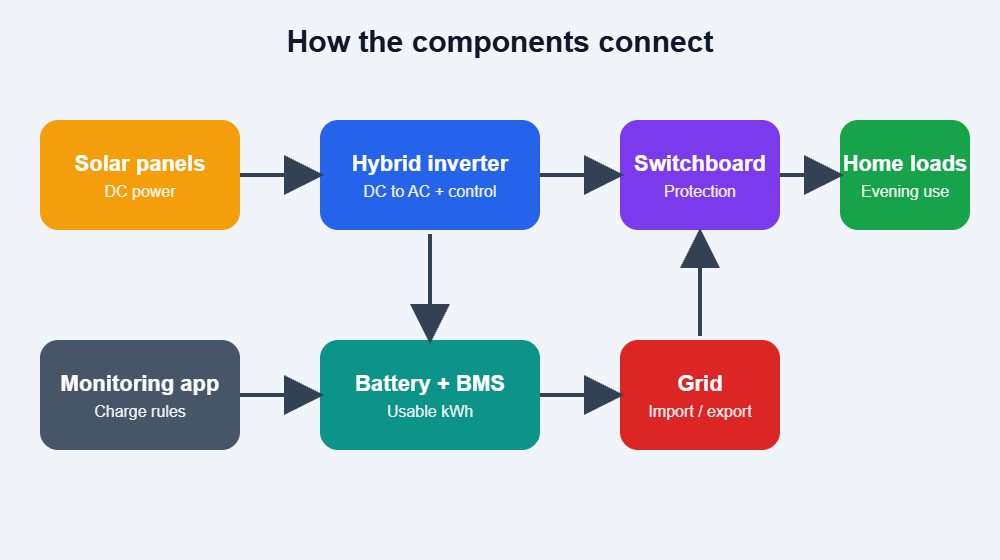
Every system has the same core building blocks, even when the product is sold as a single unit. Knowing them helps you read a quote line by line.
How energy moves through a typical solar and battery system
Illustrative. Layout varies by system. Hybrid (DC coupled) and AC coupled systems route power differently.
Battery modules and battery management
The battery stores the energy. Home batteries sold in Australia are mostly lithium-based, and capacity is measured in kWh. Look for two figures: nominal capacity, which is the total size, and usable capacity, which is the energy you can actually draw. Rebates and fair price comparisons use usable capacity.
Inside the battery, a battery management system (BMS) monitors temperature, voltage and charge to protect the cells.
Inverter
An inverter converts the direct current (DC) from solar panels and batteries into the alternating current (AC) your home uses. There are two common layouts.
- DC coupled (hybrid inverter): solar and battery share one inverter. This is common in new solar and battery packages.
- AC coupled: the battery has its own inverter and connects on the AC side. This is common when adding a battery to existing solar.
Your existing inverter is one of the biggest factors in retrofit cost.
Energy management and monitoring
Software decides when the battery charges and discharges. It can prioritise self-consumption, follow time-of-use tariffs or respond to a virtual power plant (VPP) program. A monitoring app shows what the system is doing, so you can check it is performing as designed.
Switchboard, protection and backup equipment
Isolators, circuit protection, cabling and sometimes a switchboard upgrade connect the battery safely to your home. Not every battery system provides power during a blackout. Backup usually needs a compatible inverter and extra wiring, so confirm in writing which circuits are covered.
Enclosure, mounting and location
Wall brackets, floor mounts and, in some cases, weather protection hold the battery in a compliant position. Location rules are covered in the compliance section below.
How much do residential energy storage systems cost?
Installed cost is driven by usable capacity, brand, whether you need a new inverter, the complexity of the install and what the quote includes. Larger batteries generally cost less per kWh because a share of the installation work is fixed regardless of size.
| Cost driver | Why it changes the price |
|---|---|
| Usable capacity (kWh) | The main driver of battery cost |
| Inverter | A hybrid or compatible inverter may be needed |
| Backup capability | Extra wiring and equipment for blackout protection |
| Switchboard and cabling | Older or crowded switchboards may need upgrades |
| Install location | Long cable runs and fire-rated barriers add work |
| Rebate and GST | The final price depends on how these are shown |
For a benchmark, the Solar Choice Battery Price Index (updated quarterly from its network of over 400 installers) lists average installed costs for battery-only and battery plus inverter systems. Check the index for the current date and whether figures include the rebate before using them.
Average installed cost by usable battery size (AUD)
5 kWh battery only
$5,425
5 kWh battery + inverter
$7,325
6 kWh battery only
$6,270
6 kWh battery + inverter
$8,550
7 kWh battery only
$7,245
7 kWh battery + inverter
$8,995
Battery onlyBattery + inverter
Source: Solar Choice Battery Price Index. Averages change each quarter, so confirm current figures and whether they include the rebate.
Ask every installer for the same three items: the final price after rebate, the usable kWh and a list of what is included. Divide the price by usable kWh and you can compare quotes fairly. Our solar and battery systems page includes a calculator to estimate your own options.
Rebates and incentives in South Australia and New South Wales
The federal Cheaper Home Batteries Program is delivered through Small-scale Technology Certificates (STCs) and administered by the Clean Energy Regulator. It applies to eligible batteries commissioned on or after 1 July 2025, and a site can claim once.
From 1 May 2026 the support is tiered by usable capacity:
Share of the certificate factor applied, by capacity band
First 14 kWh
100%
Next 14 kWh (14 to 28)
60%
Next 22 kWh (28 to 50)
15%
Source: Cheaper Home Batteries Program settings from 1 May 2026 (Clean Energy Regulator). Each percentage applies only to capacity inside that band. Certificates apply to no more than the first 50 kWh of usable capacity.
The factor also steps down every six months until 2030, so installation date matters. Program rules change, so check your 2026 battery rebate eligibility with your installer and on our rebate page.
State support differs:
- South Australia: eligible households can access the federal program. Through the Retailer Energy Productivity Scheme, some retailers also discount batteries for households joining a VPP.
- New South Wales: the state household battery discount under the Peak Demand Reduction Scheme ended for batteries from 1 July 2025. A VPP incentive may still apply when you connect an eligible battery, so confirm current terms on the NSW Government energy site.
Compliance: standards, products and installers
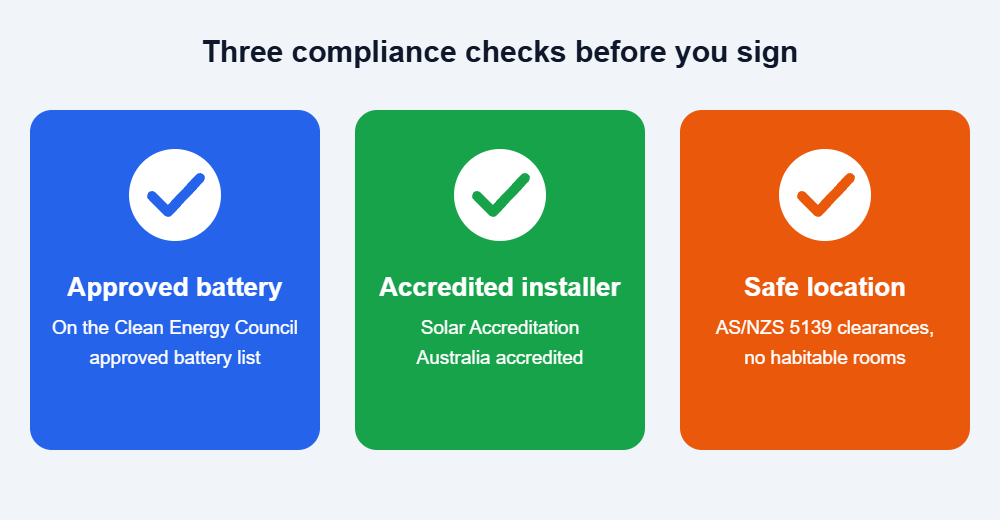
Compliance has three layers, and all three affect both safety and rebate eligibility.
The three layers of a compliant home battery installation
1. Installation standardAS/NZS 5139:2019 sets safety requirements for battery systems connected to power conversion equipment.
2. Approved productFor the federal program, the battery must be on the Clean Energy Council approved list, 5 kWh to 100 kWh nominal.
3. Accredited installerInstalled by, or under on-site supervision of, a Solar Accreditation Australia accredited battery installer.
- Installation standard. AS/NZS 5139:2019 sets the safety requirements for battery systems connected to power conversion equipment. It uses a risk-based approach to choose installation methods.
- Approved product. For the federal program, the battery must be on the Clean Energy Council approved battery list, with nominal capacity between 5 kWh and 100 kWh. Approved batteries have been tested against the industry’s electrical safety guide, which streamlines installation requirements.
- Accredited installer. The installation must be completed by, or under on-site supervision of, a battery installer accredited by Solar Accreditation Australia. The Clean Energy Regulator also inspects installations.
Location matters too. Under AS/NZS 5139, batteries generally cannot go in habitable rooms such as bedrooms or living areas, and must stay clear of evacuation routes, with ventilation and fire clearances built into the design. A good installer will assess your site before quoting.
A checklist to use before you sign
- Confirm the battery model is on the current Clean Energy Council approved list.
- Ask for the installer’s Solar Accreditation Australia details.
- Get usable kWh, not just nominal kWh, in writing.
- Check whether the price is shown before or after rebate and GST.
- Ask what happens if your inverter or switchboard needs upgrading.
- Confirm whether the system provides backup and for which circuits.
- Read any VPP contract separately from the rebate.
When a battery is not the right move
A battery is not automatically the right purchase. If you use little electricity in the evening, export very little solar or have a small system, the savings may not justify the cost. It can also make sense to improve efficiency or adjust your solar before adding storage. A proper assessment of your bills and usage will tell you. See an example of a real SA installation in our Tremett House project, which pairs 13.2 kW of solar with a 10.1 kWh battery.
Frequently asked questions
What is a residential energy storage system?
A residential energy storage system is a battery, an inverter and control equipment installed at a home to store electricity for later use. It usually charges from rooftop solar or the grid and supplies your home in the evening or at peak times. Some systems also provide backup during a blackout, but that depends on the equipment and wiring.
How much does a home battery cost in Australia?
Cost depends mainly on usable capacity, whether you need a new inverter, and installation complexity. Solar Choice’s Battery Price Index lists average installed costs by size and updates them quarterly, so check the current figures before comparing quotes. Ask for a written price after any rebate, divided by usable kilowatt-hours, so each quote is compared on the same basis.
Do I need a Clean Energy Council approved battery?
For the federal Cheaper Home Batteries Program, yes. Program rules require eligible batteries to be on the Clean Energy Council approved battery list, have a capacity between 5 kWh and 100 kWh, and be installed by, or under on-site supervision of, a Solar Accreditation Australia accredited installer. A battery that is not approved will not attract the federal rebate.
Can I add a battery to my existing solar system?
Often yes. The federal program supports batteries added to new or existing rooftop solar. Whether yours suits a retrofit depends on your current inverter, your switchboard and whether the battery is AC coupled or DC coupled. An assessment of your existing equipment will show whether you need a hybrid inverter or other upgrades.
Where can a home battery be installed?
AS/NZS 5139 restricts where a battery can go. Batteries generally cannot be installed in habitable rooms such as bedrooms, and installers must keep them clear of evacuation routes and allow for ventilation and fire safety clearances. Garages and external walls are common locations, subject to the installer’s risk assessment of your property.
Is the battery rebate a flat 30% discount?
No. The program was described as around 30 per cent off at launch, but from 1 May 2026 support is tiered by battery size and the certificate factor steps down every six months. The final discount depends on your usable capacity, installation date and eligibility, so check your 2026 battery rebate eligibility before relying on any figure.
Plan your system with a local assessment
The right residential energy storage system matches your evening usage, your solar and your property. To see what suits your home in Adelaide or Sydney, request a free battery assessment and we will review your bills, equipment and eligibility with you.
Sources
- Clean Energy Regulator, Cheaper Home Batteries program
- Solar Choice, Battery Price Index