

Why South Australia and NSW Are Leading Australia’s Home Battery Boom
Australia’s home battery market has entered a major growth phase in 2026. Falling technology costs, rising electricity prices, rooftop solar adoption and government incentives are encouraging more households to store their own solar energy rather than export excess electricity to the grid.
For homeowners in South Australia (SA) and New South Wales (NSW), this trend is particularly important. Both states are among Australia’s strongest markets for residential solar and battery storage, although their adoption stories are quite different.
According to the Clean Energy Regulator (CER), 304,177 solar battery systems were recorded across Australia in 2026, with NSW accounting for 105,454 installations and South Australia 31,231
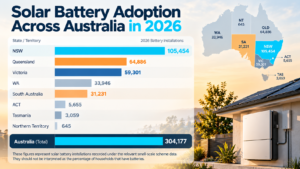
These figures represent solar battery installations recorded under the relevant small-scale scheme data. They should not be interpreted as the percentage of households that have batteries. Clean Energy Regulator
NSW is clearly the largest market by installation volume, while SA stands out when battery penetration is considered relative to its household base.
South Australia: One of Australia’s Battery Leaders
South Australia has developed one of the strongest residential battery markets in Australia.
The South Australian Government reports that more than 11% of homes had batteries as of January 2026, based on SA Power Networks data.
That is significant because South Australia already has a very high level of rooftop solar adoption.
The state has also developed a broader battery ecosystem, ranging from household batteries to community and grid-scale storage.
As of April 2025, SA had approximately 49,275 homes with one or more residential batteries, with combined capacity exceeding 620 MWh.
Why are South Australians adopting batteries?
There are several reasons:
1. High rooftop solar penetration
Many homes generate more solar electricity during the day than they immediately consume.
2. Strong solar resources
South Australia’s abundant sunshine makes solar generation particularly attractive.
3. Increasing value of self-consumption
Instead of exporting excess solar and buying electricity back later, a battery allows households to shift some of their solar generation into the evening.
4. Grid flexibility
Battery systems can also participate in demand-response and virtual power plant programs.
NSW Is Australia’s Biggest Battery Installation Market
NSW is currently the largest state by the number of battery installations recorded under the national battery program.
The CER recorded 105,454 battery installations in NSW during 2026, compared with 31,231 in South Australia.
NSW also has a significant existing installed base.
The NSW Government reported that approximately 143,000 NSW households and small businesses had rooftop solar and battery systems as of September 2025, with approximately 98% being residential customers. energy.nsw.gov.au
The state’s long-term target is ambitious: NSW wants 1 million households and small businesses to have access to rooftop solar and battery systems by 2035, increasing to 1.5 million by 2050. energy.nsw.gov.au
Why Battery Adoption Is Growing So Quickly in NSW
The economics of battery storage are becoming increasingly attractive for NSW homeowners.
A solar system can generate significant electricity during daylight hours. But many households consume more electricity in the evening when solar generation has fallen.
A battery changes the timing:
Solar panels → Battery → Evening household consumption
Instead of relying entirely on grid electricity after sunset, homeowners can use stored solar energy.
NSW is also developing its Virtual Power Plant (VPP) ecosystem.
A VPP connects multiple household batteries so that stored electricity can be coordinated and supplied to the grid when required.
From July 2026, batteries up to 50 kWh can be eligible for the NSW VPP incentive, subject to the program’s conditions. energy.nsw.gov.au
What Changed for Australian Battery Incentives in 2026?
Australia’s national Cheaper Home Batteries Program has been a major driver of battery adoption.
The Clean Energy Regulator reported that the program reached more than 284,000 validated batteries and 7.4 GWh of validated usable capacity by Q1 2026.
The momentum continued into Q2.
During Q2 2026, approximately 111,000 battery installations representing 3.6 GWh of capacity were approved under the program.
However, the incentive structure changed from 1 May 2026, with revised STC settings reducing the relative upfront support and shifting demand toward smaller battery systems. Despite this change, the CER reported that demand remained strong.
This is important for homeowners considering a battery in SA or NSW: the economics should be evaluated using the incentives and electricity prices that apply at the time of installation, rather than relying on older rebate figures.
SA vs NSW: Which Market Is Leading?
There isn’t one simple answer because “leading” can mean different things.
NSW leads in installation volume
With more than 105,000 battery installations recorded in 2026, NSW is currently Australia’s largest battery market by installation numbers.
SA leads in household penetration
South Australia has more than 11% of homes equipped with batteries, making it one of Australia’s most advanced residential battery markets on a household-penetration basis.
Both states have strong solar foundations
That makes sense: battery storage becomes particularly useful when a household already has solar generation and wants to use more of that energy after sunset.
Where Does a Solar Battery Make the Most Sense?
For a typical SA or NSW household, battery suitability depends on several factors rather than simply the size of the solar system.
Consider:
Your electricity consumption
A household using significant electricity in the evening may benefit more from storage.
Your solar generation
If your solar system regularly produces more electricity than your home uses during the day, a battery can potentially increase self-consumption.
Your electricity tariff
Your retailer’s electricity rates and solar feed-in tariff can significantly affect the financial case.
Battery size
Bigger isn’t automatically better.
The right battery should be matched to your electricity usage, solar generation and desired backup requirements.
Installation location
Battery installation needs to comply with applicable electrical and safety requirements. South Australia’s government guidance, for example, recommends batteries be well ventilated, protected from direct sun and kept away from living areas; installation and servicing requirements also apply.
Battery Safety Is Becoming More Important
The rapid growth of Australia’s battery market also makes installation quality extremely important.
The Clean Energy Regulator reported that by 30 June 2026, 478,176 solar batteries had been installed across Australia since 1 July 2025, representing 13.58 GWh of storage capacity. Clean Energy Regulator
The CER’s inspection program had completed 3,425 inspections by that date. Across more than 285,000 checklist items, 93.49% were found compliant, while 1.28% required rectification and 5.23% were identified as areas for improvement. Clean Energy Regulator
For homeowners, this reinforces an important point:
Choosing the right installer is just as important as choosing the right battery.
A professional installation should consider location, ventilation, electrical protection, clearances, cabling, shutdown procedures and ongoing maintenance.
Should SA & NSW Homeowners Install a Battery in 2026?
For many households, the answer is worth investigating.
A battery can potentially help you:
- Use more of your own solar power
- Reduce reliance on grid electricity after sunset
- Shift solar energy from daytime to evening
- Improve household energy resilience
- Participate in eligible VPP programs
- Make better use of an existing rooftop solar system
However, the financial return varies significantly between properties.
There is no universal battery size or guaranteed payback period. Your electricity consumption, solar generation, tariff, battery price, incentives and installation conditions all matter.
What Solar Battery Adoption Rates Mean for You
Rising solar battery adoption rates in South Australia and NSW show that more homeowners are choosing to store their own solar instead of exporting it for very little. To see what a battery could save in your home, try our battery rebate calculator and get an estimate of your rebate, payback and bill savings in seconds. If you live in Adelaide, read our guide to solar rebates in Adelaide to understand every incentive available right now. The trend is clear, but the right system still depends on your usage, tariff and roof. Use the data, then make the decision that fits your household.